
The Collection
Gold, Diamond & Polki — the complete collection.
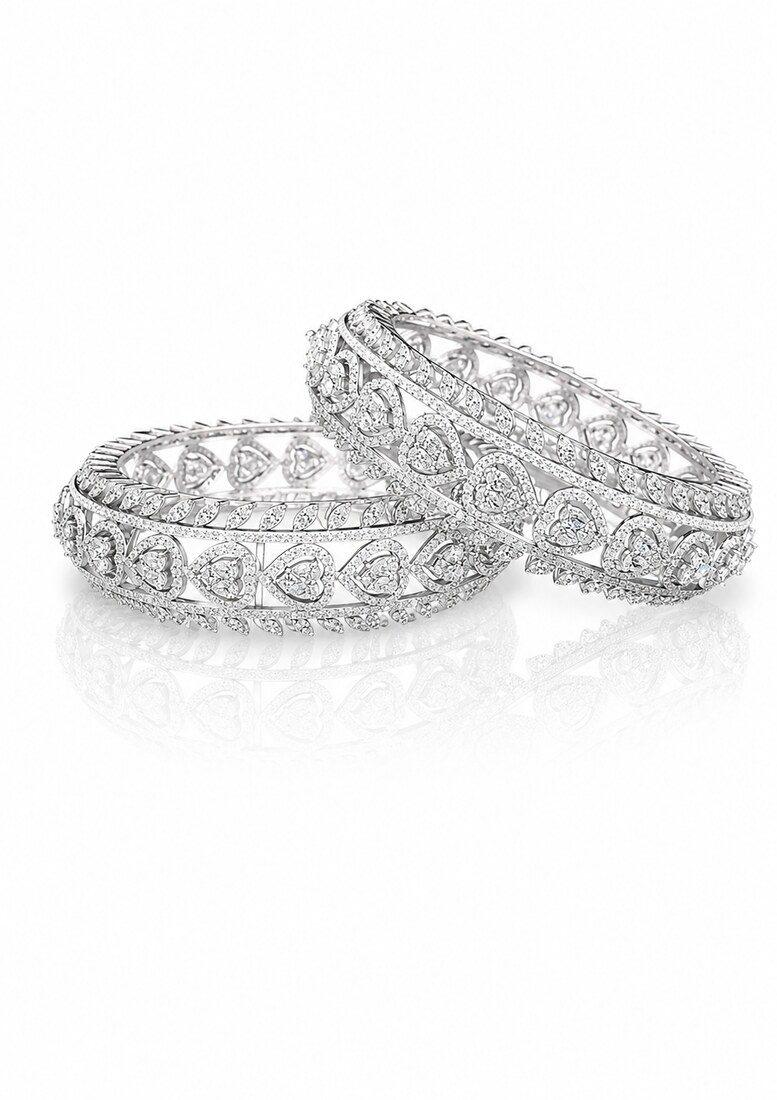
This matched pair of bangles is set edge to edge with round brilliant diamonds, so the sparkle runs unbroken all the way around the wrist. Each stone is pavé-set into 18k white gold, keeping the metal all but invisible beneath the stones. Worn together they catch the light from every angle, whether you're raising a toast or dancing until midnight. The pair sits close to the wrist for a streamlined, modern silhouette rather than a heavy stack. It's the kind of piece that looks equally at home under a chandelier or in daylight photographs, which is exactly why it's requested so often for evening and festive occasions.
Price on request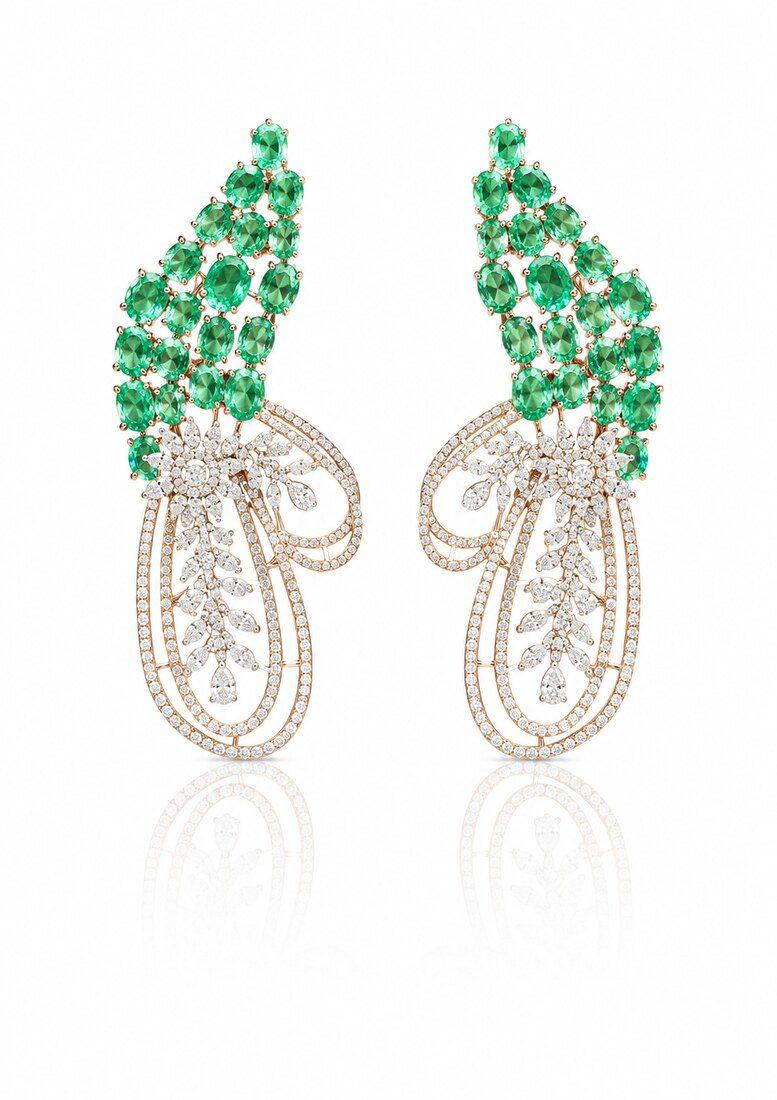
Shaped like classic paisley drops, these earrings carry natural emeralds cradled inside a frame of pavé diamonds. The paisley motif is a deliberate nod to traditional Indian jewellery design, reworked here in 18k gold for a lighter, more wearable drop. Light plays differently across the diamond edge and the deep green centre, giving the earrings a two-tone shimmer as they move. They sit at a comfortable mid-length, so they show beautifully with an updo without overwhelming the neckline. A dependable choice for festive gatherings and parties where you want colour without going overboard.
Price on request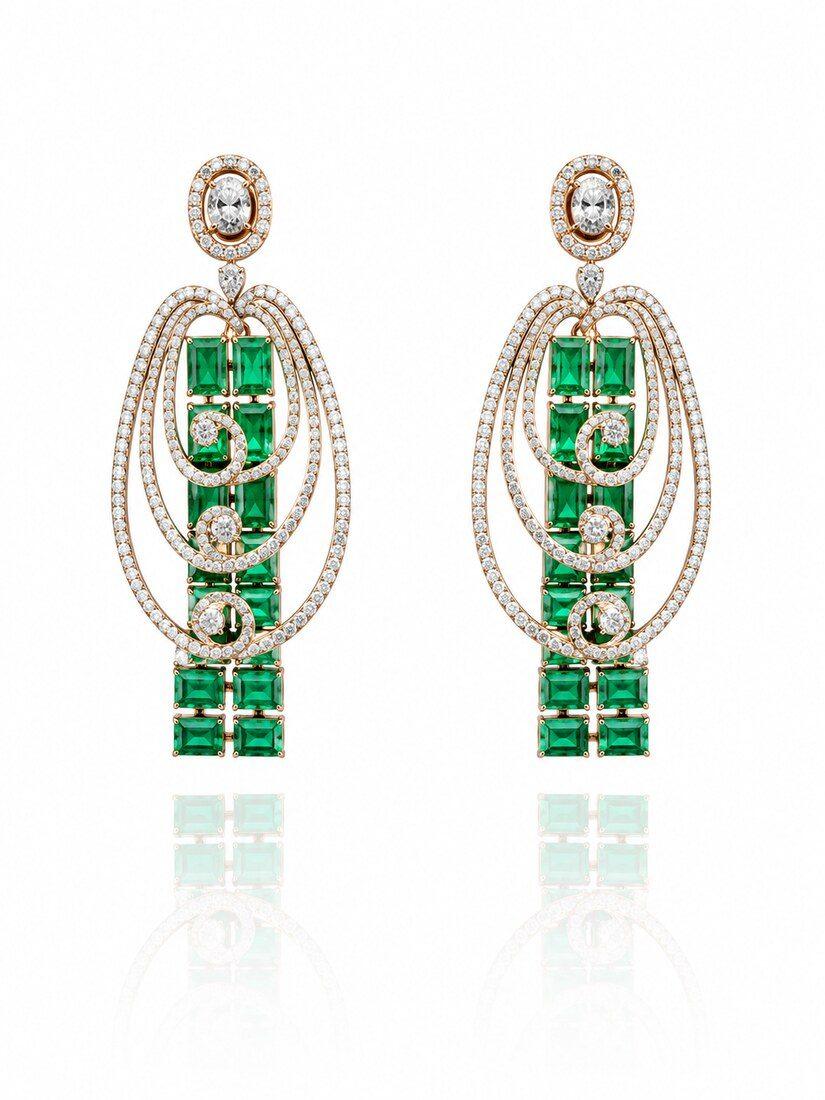
These danglers run long and lean, tapering from a diamond-set top down to a single emerald drop at the base. The diamonds are prong-set so more light reaches each stone, and the emerald swings gently as you move, catching the eye without needing to be flashy. Because the design narrows toward the bottom, the earrings elongate the neckline rather than crowding it. They're built for evening wear — the kind of piece that looks its best under warm light, with hair swept back to let the full length show.
Price on request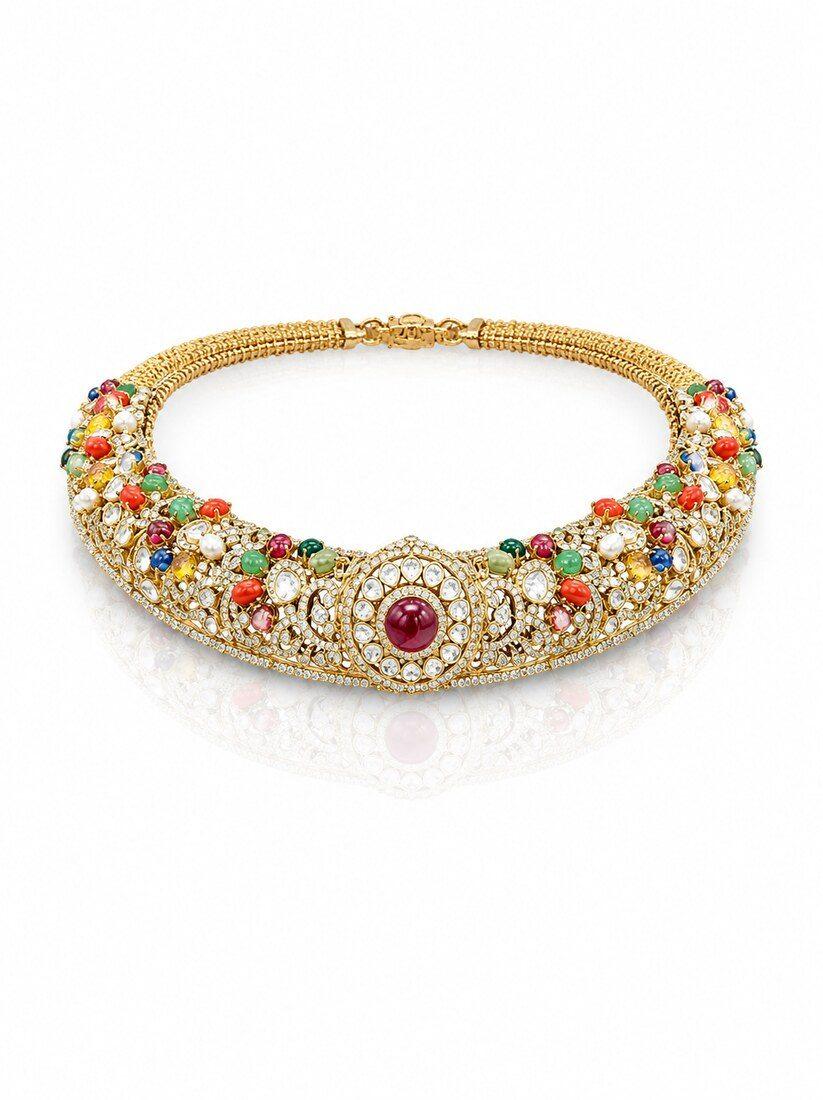
A polished gold choker built around a central cluster of rubies and diamonds, this piece sits high and close to the throat in the classic choker silhouette. The ruby cluster anchors the design, with diamonds fanning outward to soften the transition into plain gold. It reads formal without tipping into overly ornate, which is why it works equally well for a wedding function or a festive evening out. The gold is left polished rather than textured, so the stones stay the clear focal point. Pairs naturally with a simple sari or lehenga where the neckline is meant to do the talking.
Price on request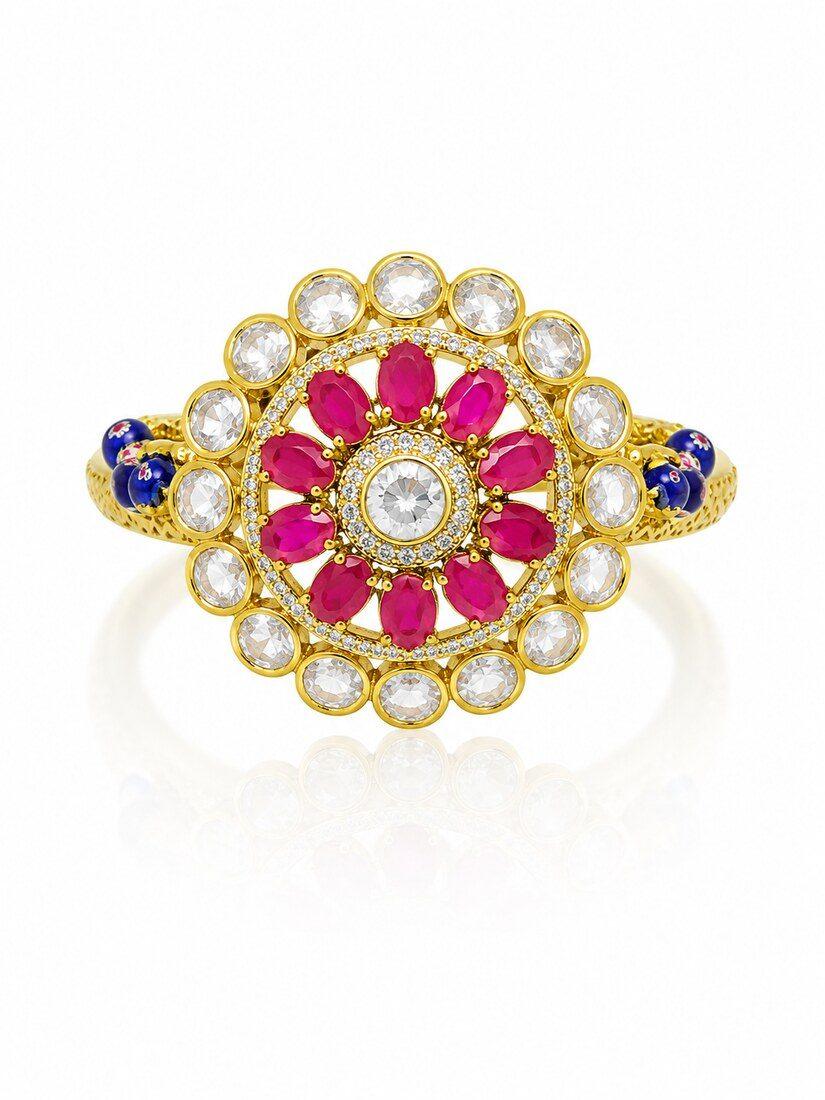
This cocktail ring takes the shape of an open flower, its petals hand-set with a mix of rubies, sapphires and uncut diamonds rather than a single repeated stone. That mix is what gives it depth — no two petals catch the light quite the same way. The uncut diamonds add texture against the smoother-cut coloured stones, a detail that only really shows up close. It sits fairly high off the finger, so it's built to be noticed rather than worn as an everyday band. Best saved for cocktail hours and festive evenings where a statement ring has room to be the centre of attention.
Price on request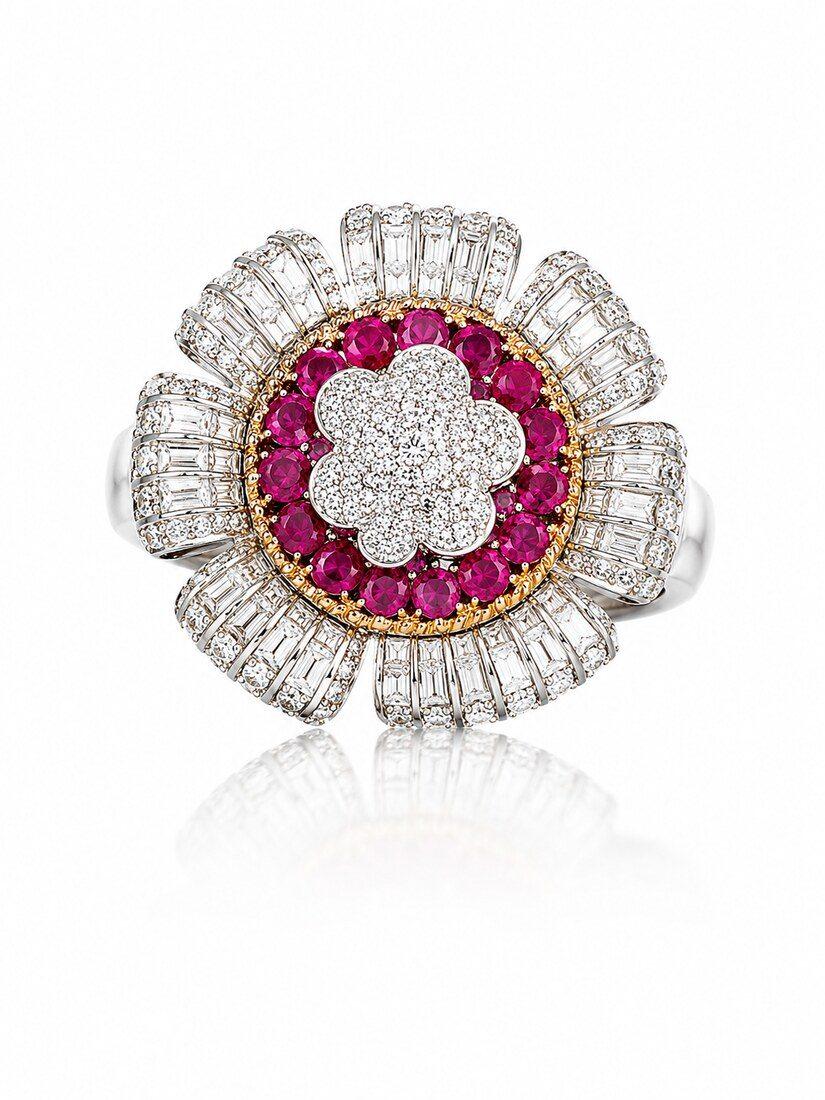
Baguette-cut diamonds fan out here like petals around a ruby-lined centre, giving the ring a clean, architectural take on a floral motif. The straight lines of the baguettes contrast nicely with the round brilliants filling in between them, so the design doesn't read as too rigid or too soft either way. It's a ring that photographs well from directly above, which is part of why it's become a cocktail-wear favourite. The ruby centre keeps just enough warmth in an otherwise mostly-white design. A good pick if you want a statement ring that still feels considered rather than loud.
Price on request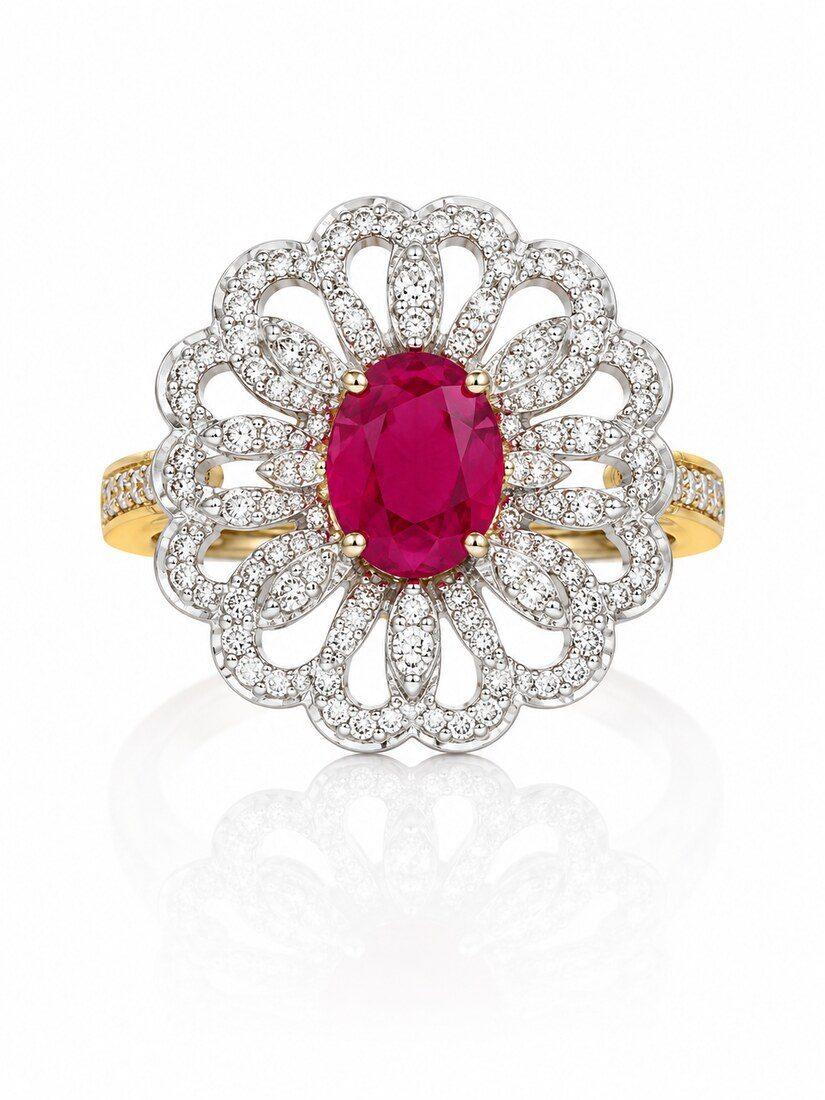
A deep, saturated ruby sits at the heart of this ring, held inside not one but two halos of brilliant-cut diamonds. The double halo does a lot of work visually — it makes the central stone look larger than it is and adds a ring of movement around it. Because the ruby is a natural stone, its colour has the kind of depth that's hard to replicate, especially under indoor lighting. This is a ring that's meant to be seen at a distance across a room, which makes it a natural fit for cocktail parties and evening celebrations. Comfortable enough to wear for a full evening without the setting catching on clothing.
Price on request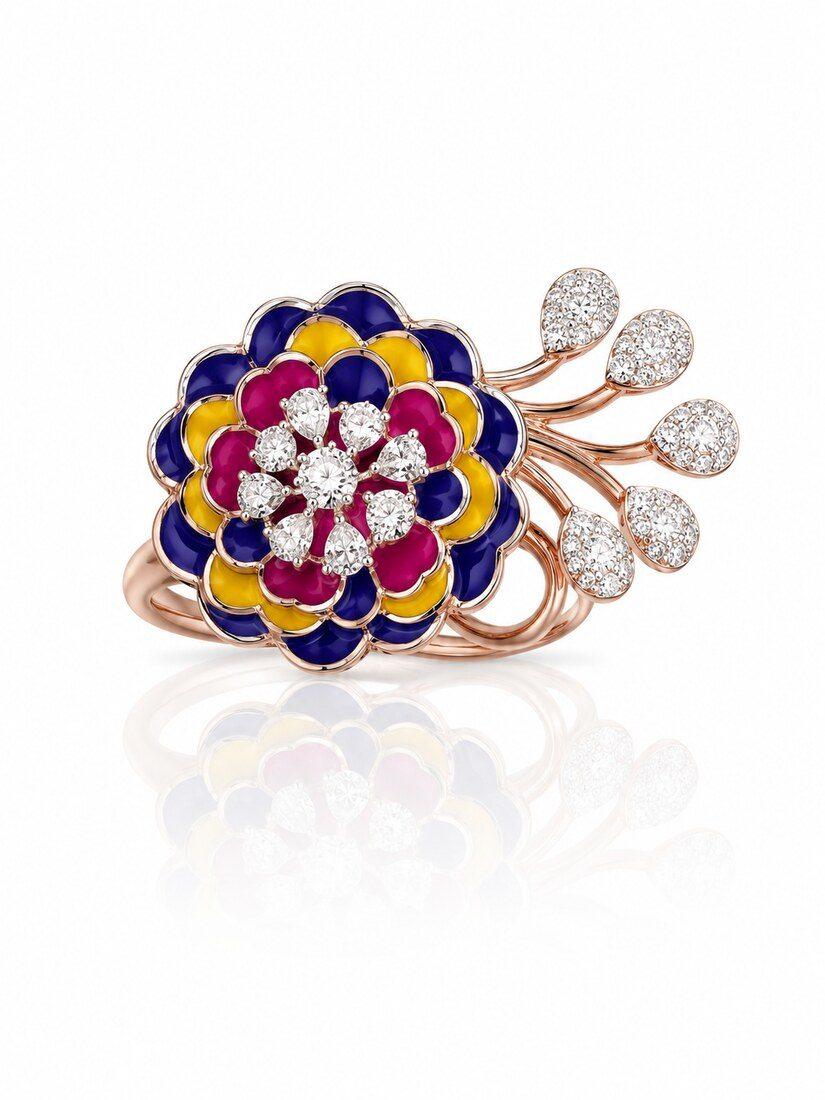
Blue meenakari enamel forms the base of this ring, with diamond clusters worked into the sculpted floral pattern on top. Meenakari is a slow, hand-painted enamelling technique, and the colour here is fired directly onto the gold rather than layered separately — it won't chip or fade the way cheaper enamel work can. The diamonds are placed to catch light against the flat colour of the enamel, so the ring reads as both textured and sparkling depending on the angle. It leans more festive than everyday, pairing naturally with traditional outfits where blue or jewel tones are already part of the palette.
Price on request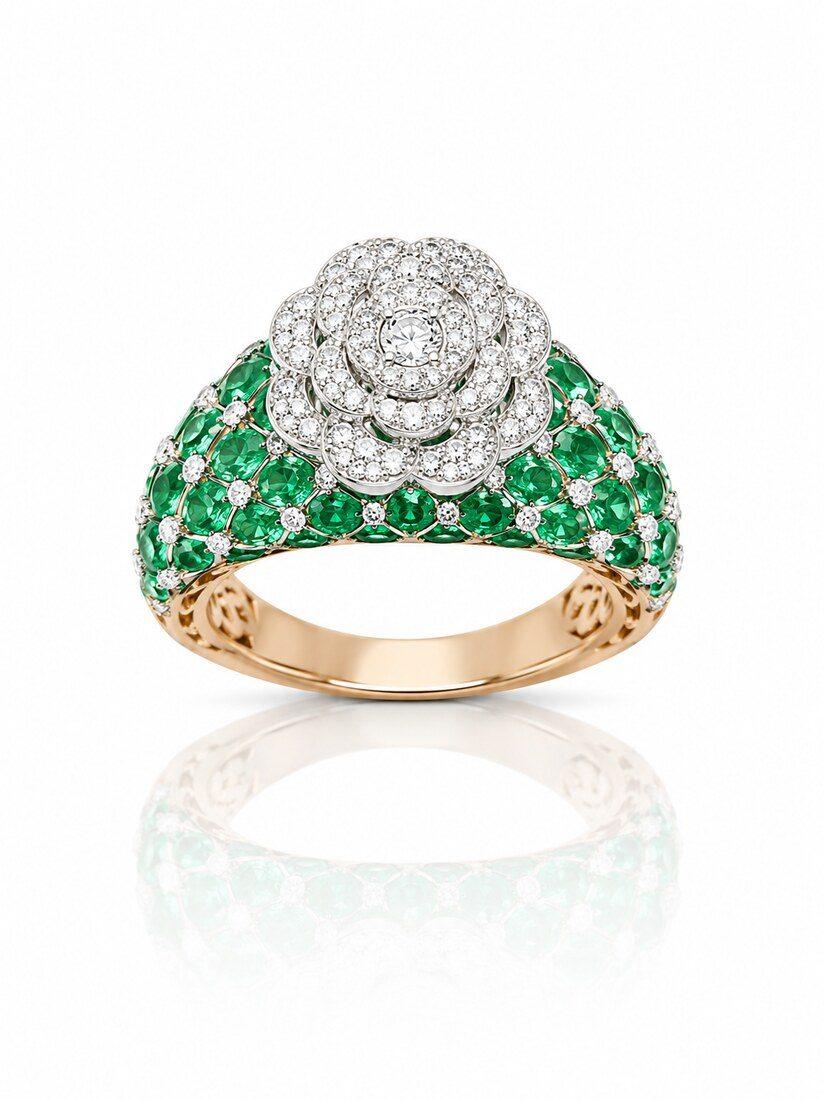
This dome ring builds up in layers of micro-pavé diamonds, all converging on a single emerald set dead centre. The dome shape gives it real presence on the hand without the ring feeling bulky, since the pavé work keeps the surface light rather than solid. Micro-pavé takes considerably more setting time than standard pavé because the stones are smaller and packed tighter, which is part of what gives the surface its dense sparkle. The emerald anchors the whole piece with a single point of colour. A strong choice for party wear when you want one ring to do the work of a whole hand of jewellery.
Price on request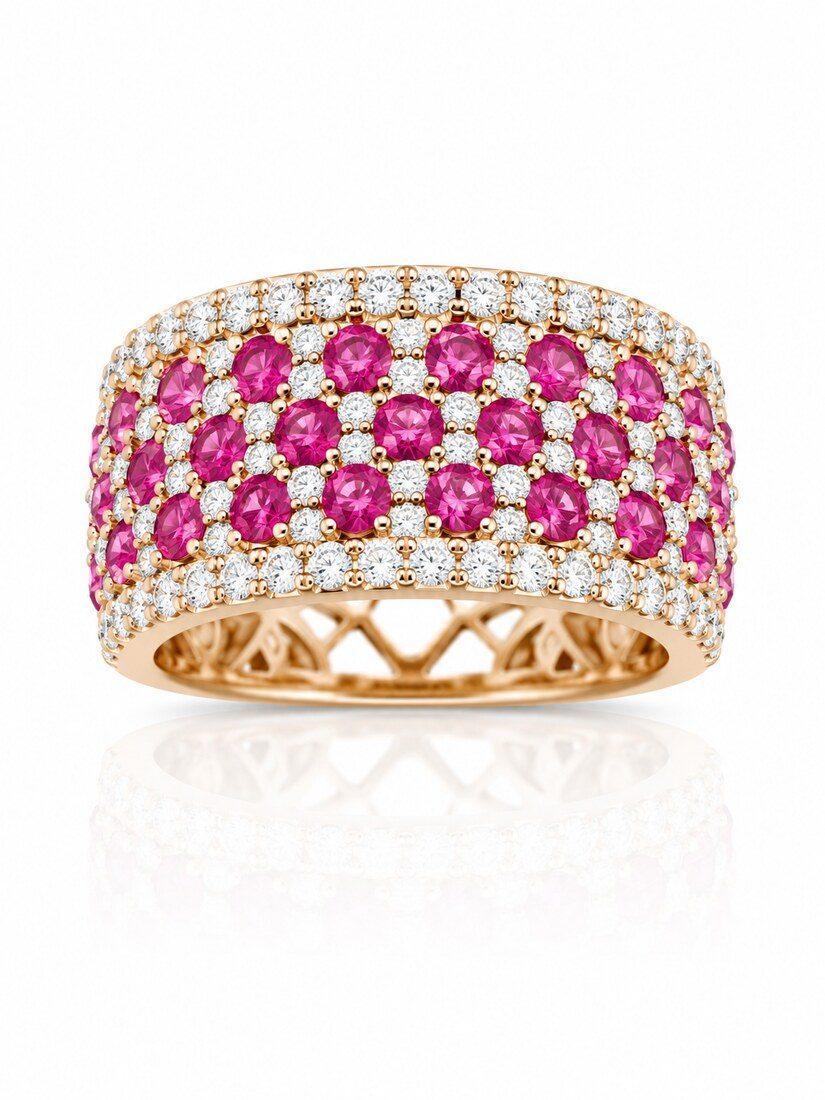
Rubies and white diamonds alternate across this broad band, set using a combination of channel and pavé techniques so the stones sit flush and secure rather than raised. That flush setting is deliberate — it means the band doesn't snag on fabric or hair, which makes it genuinely wearable day to day and not just for special occasions. The alternating colour pattern keeps the eye moving around the band rather than settling on one point. It's substantial enough to hold its own at a party but low-profile enough that you could reasonably wear it to work the next morning.
Price on request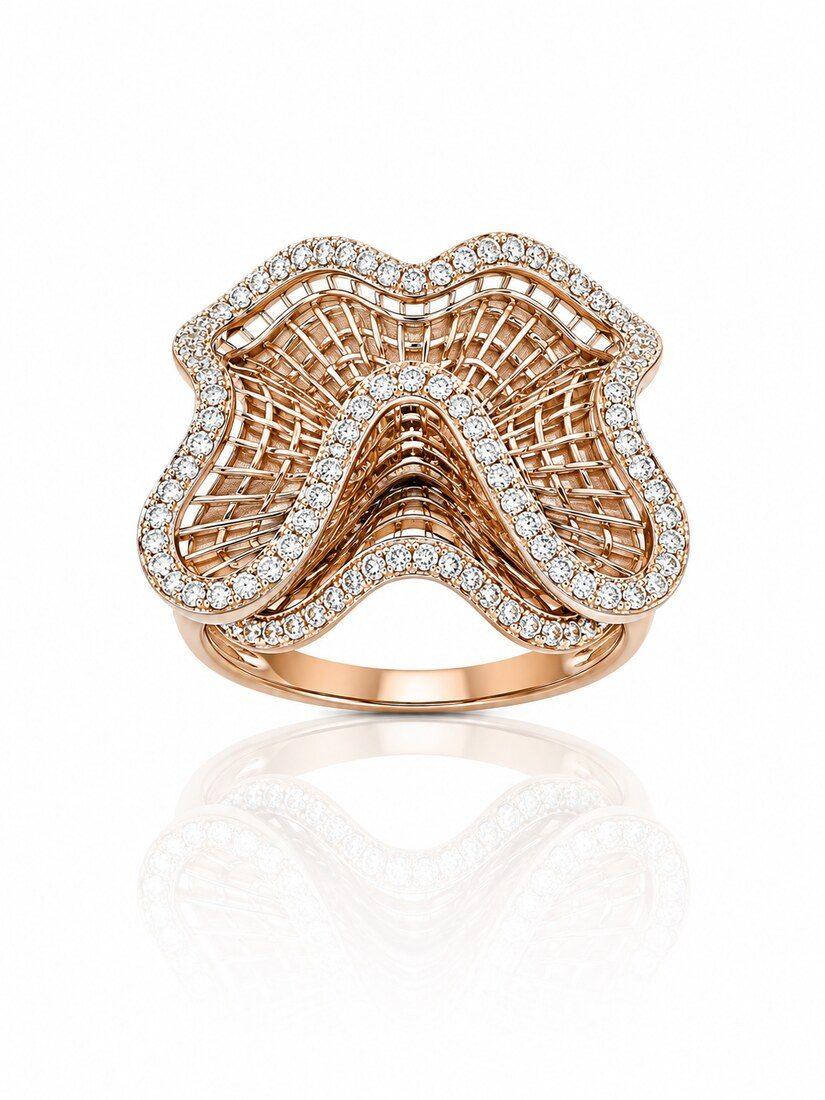
Rather than a straight band, this ring curves in a single sculptural wave, entirely micro-pavé set with diamonds along its length. The wave shape means the ring catches light differently depending on which way your hand is turned, so it never looks quite static. Because the setting is micro-pavé rather than larger individual stones, the surface reads as continuous sparkle rather than a row of separate diamonds. It's slim enough to wear alone or stack with a plainer band on the same finger. Equally suited to a regular day and a proper evening out, which is part of its appeal.
Price on request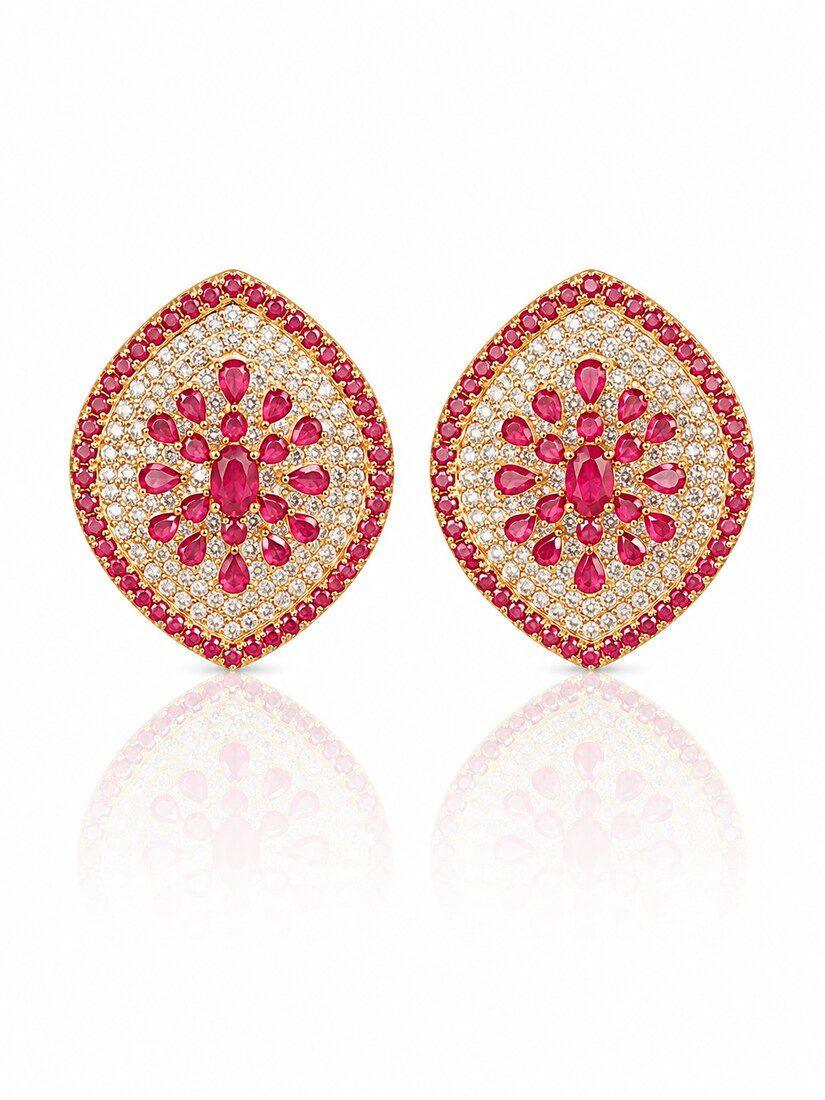
These studs fan outward from the earlobe in a half-circle of channel-set rubies, edged with a border of white diamonds. Channel setting holds each ruby tightly between two metal walls, which gives the fan shape its clean, unbroken edge rather than individual prongs interrupting the line. The diamond border does the job of framing the rubies without competing with them for attention. Because they sit close to the ear rather than dangling, they work well under a dupatta or veil without getting tangled. A dependable studs option for festive days that call for something more finished than plain gold.
Price on request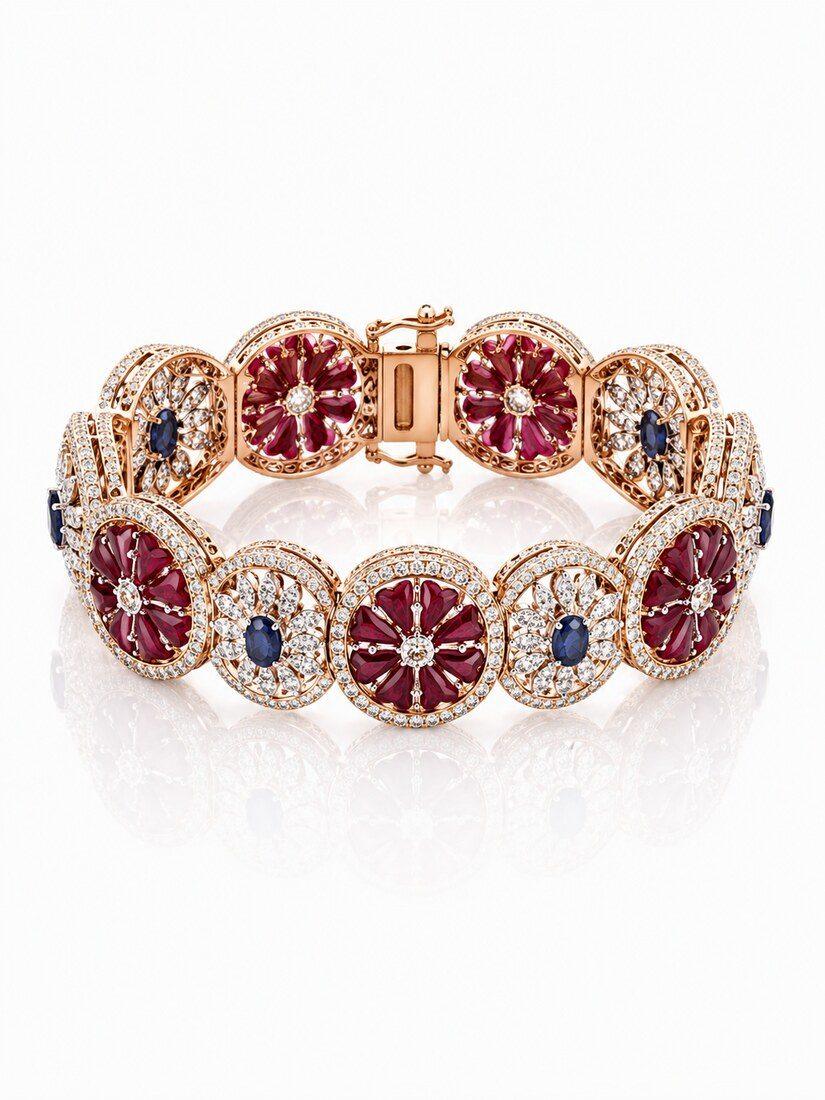
Oval rubies are linked one after another here, each surrounded by its own halo of diamonds, running the full length of the bracelet in warm gold. The repeated halo pattern gives it rhythm — your eye moves link to link rather than landing on one central stone. Natural rubies vary slightly in tone from one to the next, and that's left visible rather than colour-matched into uniformity, which is part of what gives the bracelet its handmade character. It sits flat and comfortable against the wrist rather than sitting proud. Good for festive occasions and parties where a bracelet needs to hold its own next to other jewellery.
Price on request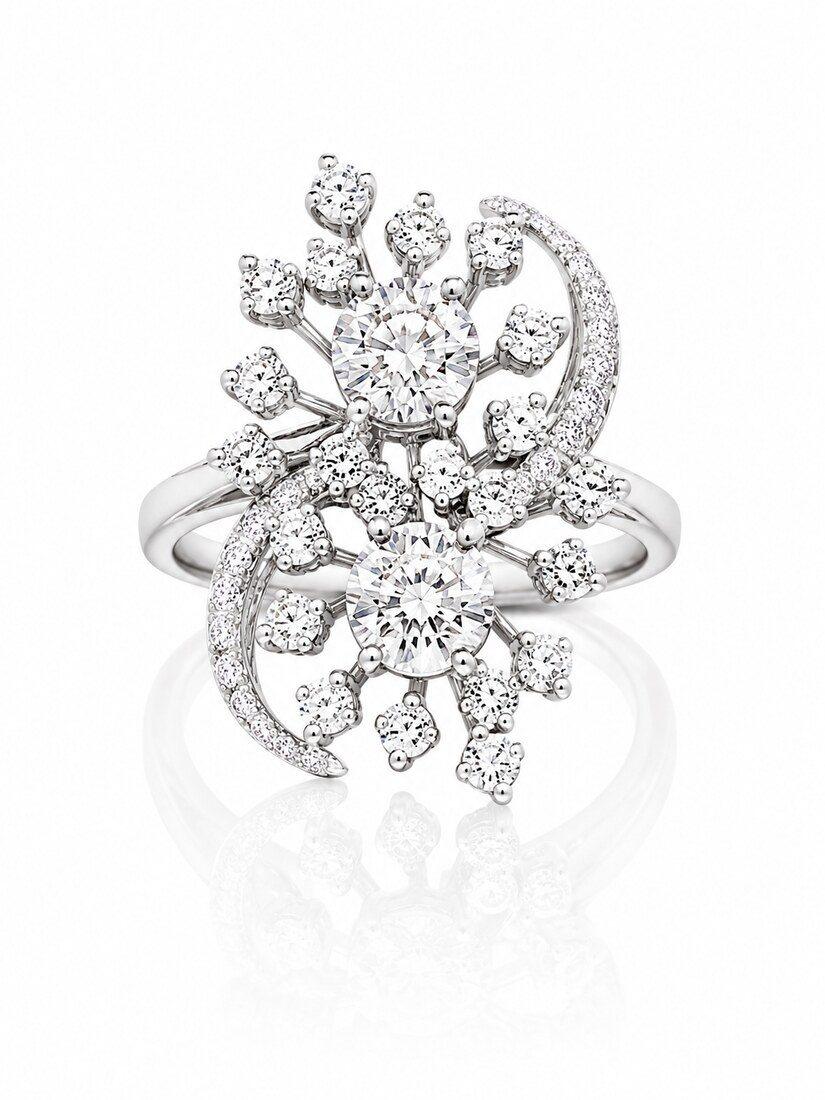
Round brilliant diamonds spray outward from a central point in this ring, prong-set so each stone is raised just enough to catch independent light. The open floral arrangement leaves negative space between the stones rather than packing them edge to edge, which keeps the ring from feeling heavy despite its size. Set in white gold, the metal recedes and lets the diamonds read as pure sparkle without any warm undertone competing for attention. It's built for cocktail hours and evening events — the kind of ring that looks its best from across a dimly lit room.
Price on request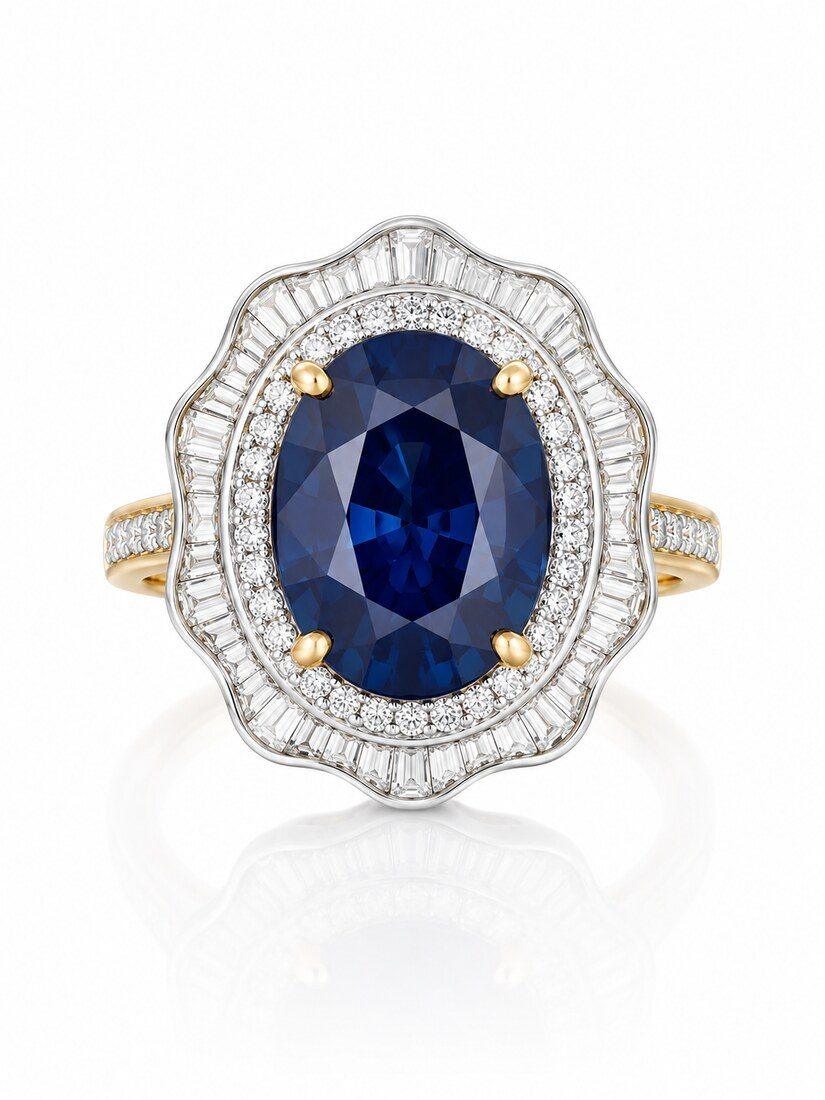
A deep blue natural sapphire sits at the centre of this ring, surrounded by a crown of diamonds in a classic halo setting. The halo does double duty — it makes the sapphire appear larger and adds brilliance around a stone that, being a natural sapphire, already carries real depth of colour. This is a design that's been chosen often for engagements, where a coloured centre stone is wanted instead of a plain diamond solitaire, though it wears just as well for a formal evening. Set in warm gold, the blue reads richer than it would against white metal.
Price on request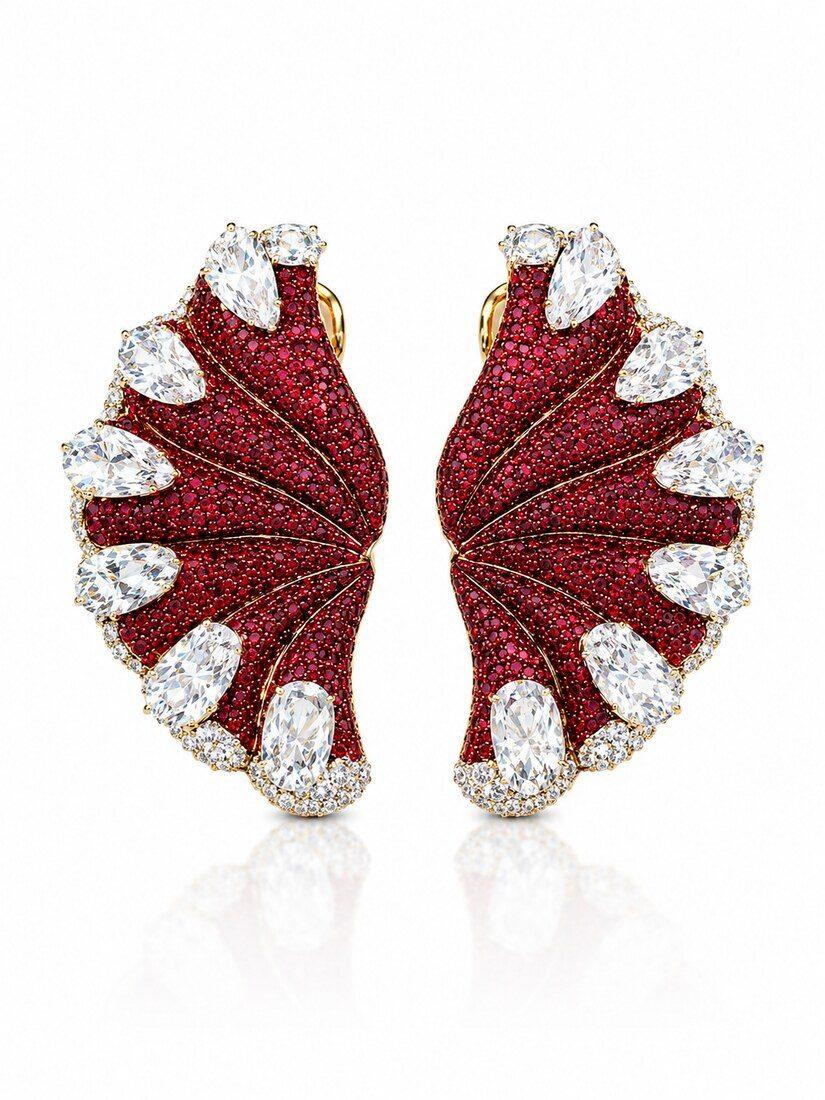
These earrings take a dramatic wing shape, channel-set with rubies along the sweep and tipped with diamonds at the point. The wing silhouette is bolder than a standard drop earring, extending outward rather than just down, so they're designed to be seen in profile as much as head-on. Channel setting keeps the rubies flush and secure along the curve of the wing. Because of their size and shape, they're best suited to occasions where your hair is styled away from the face — festive functions and parties where the earrings are meant to be a visible part of the look.
Price on request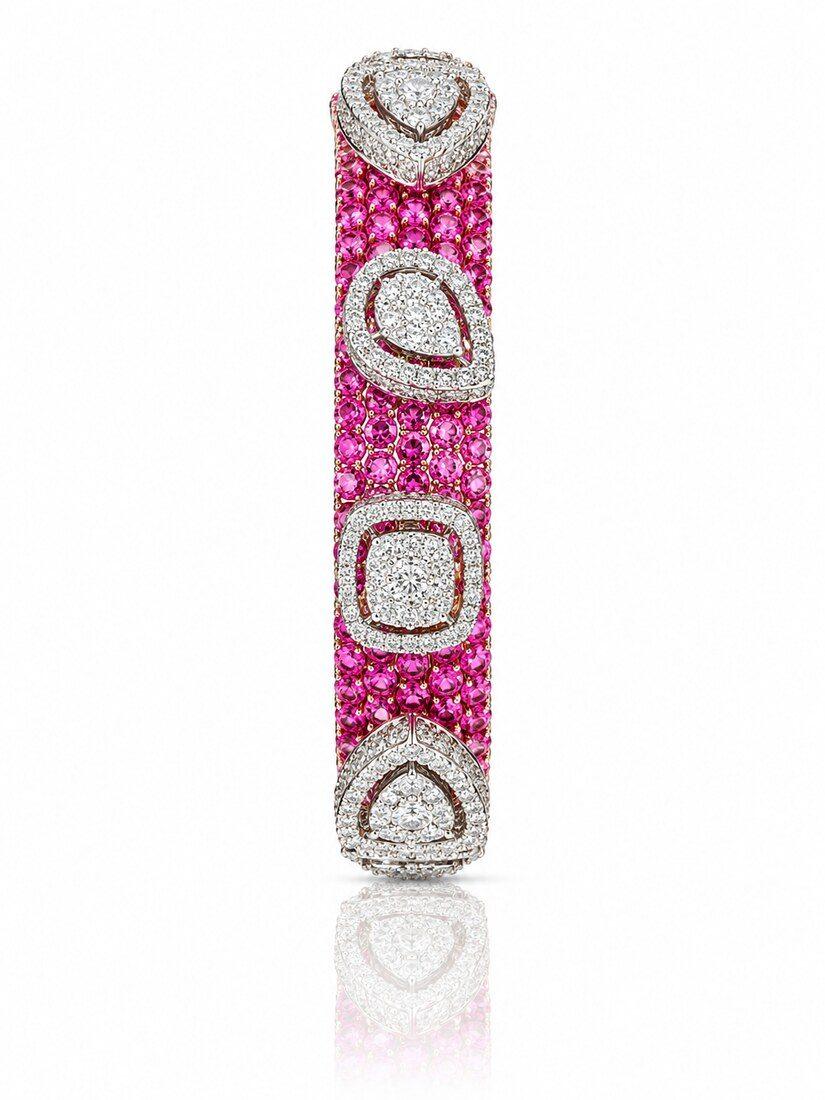
This broad bracelet combines two very different textures — pavé-set pink sapphires alongside uncut polki diamonds — in the same warm gold band. Polki is uncut, unfaceted diamond, so it has a softer, more mirror-like glint compared to the more precise sparkle of the faceted pink sapphires next to it. Putting both in one piece is a fairly modern styling choice, blending a traditional stone with a more contemporary pink sapphire palette. It's a substantial piece meant to be worn solo rather than stacked, ideal for festive and party occasions where you want colour and texture both.
Price on request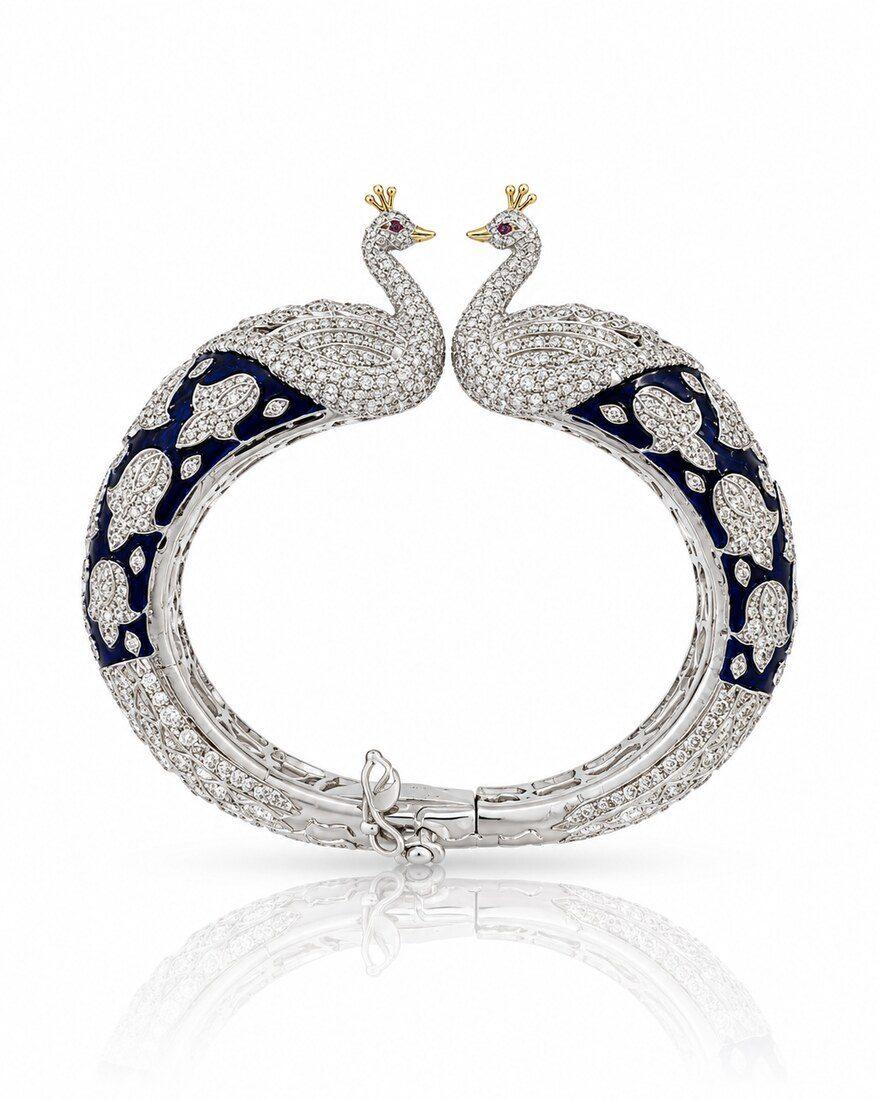
Two peacocks in blue enamel meet nose to nose on this hinged kada, their feathers picked out in rose-cut diamonds. The hinge mechanism lets it open and close around the wrist rather than needing to slide over the hand, which matters given how substantial this piece is. Enamelling on a men's kada is a traditional technique that's become harder to find done well, since it requires firing colour directly onto gold without disturbing the diamond settings nearby. Made for festive and bridal occasions where a groom's or father's jewellery needs real presence on the wrist.
Price on request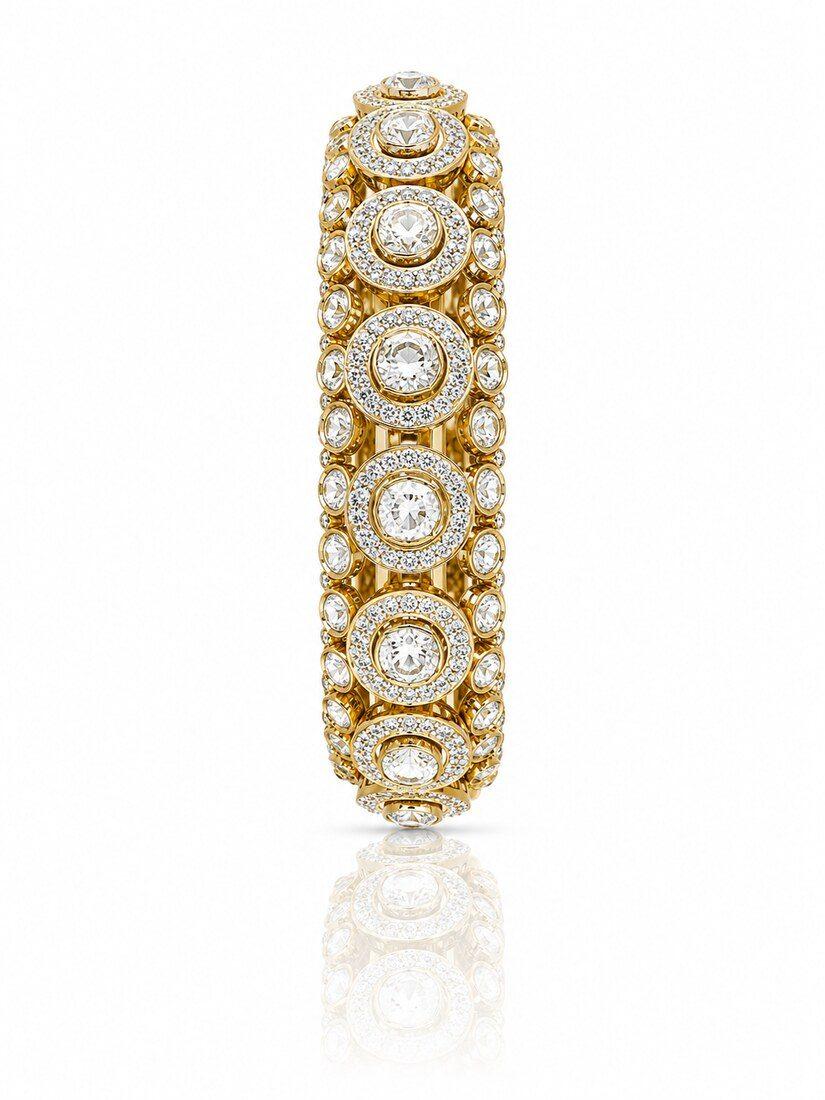
Diamond clusters run end to end around this broad gold bangle, packed close enough that very little bare metal shows between them. Cluster setting groups several smaller stones together to read as one larger area of sparkle, which is a practical way to achieve a fuller look without the cost of larger individual diamonds. The bangle has real weight and presence on the wrist, the kind of piece that's felt as well as seen. A strong choice for festive wear when you want one bangle to anchor the whole hand rather than building a stack.
Price on request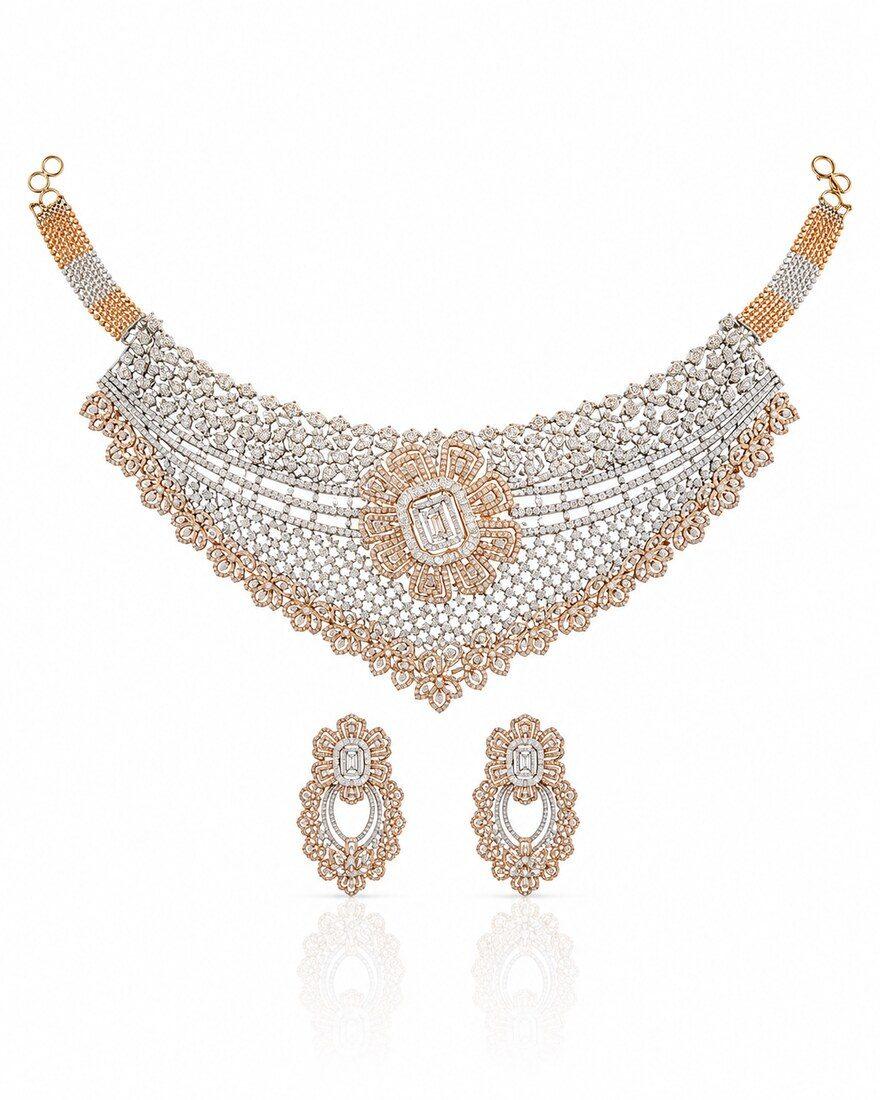
This necklace scallops gracefully across the collarbone in rose gold, prong and pavé set with diamonds, with matching drops completing the set. Rose gold is a warmer, pinkish alloy compared to standard yellow or white gold, and it photographs particularly well against most skin tones, which is part of why it's become popular for reception wear. The scalloped shape follows the natural curve of the neckline rather than sitting as a straight line, so it drapes rather than sits rigid. Understated enough for evening wear beyond just the reception itself.
Price on request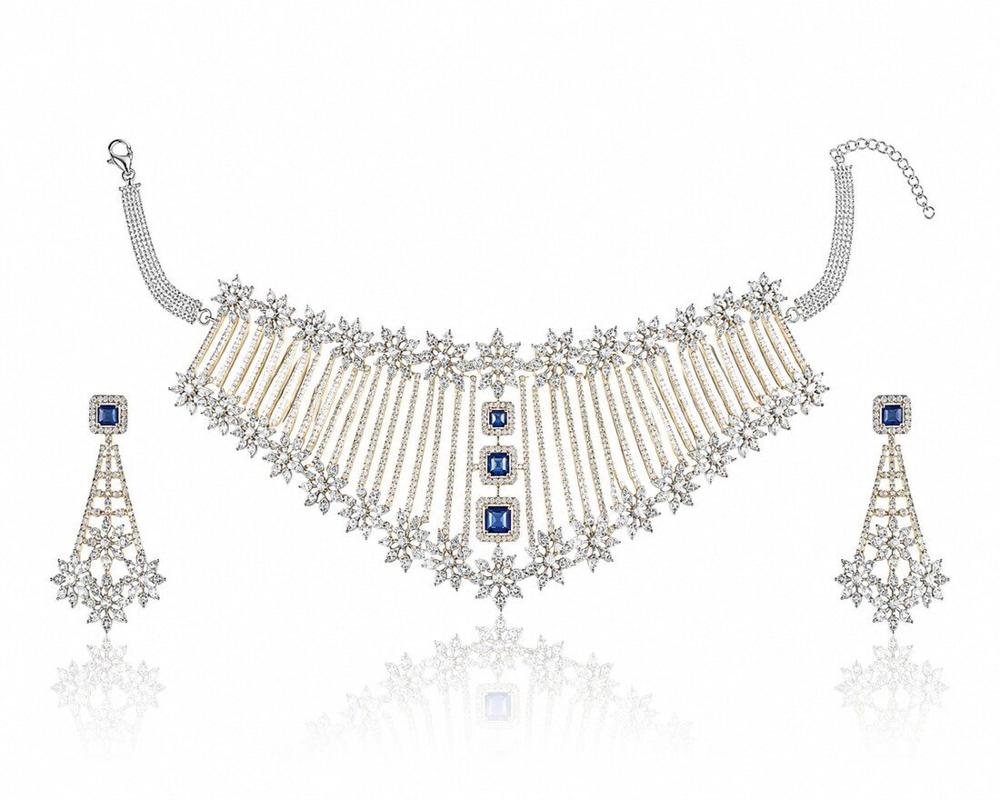
A fringe of diamonds falls from this collar necklace, each strand finished with a single blue sapphire drop at the end. Fringe settings like this rely on movement — the strands aren't rigid, so they shift slightly as you walk or turn your head, catching light unevenly rather than all at once. Set in white gold, the diamonds stay bright while the sapphire drops provide the only colour in an otherwise monochrome piece. Designed with reception wear in mind, where the necklace needs to photograph well under both daylight and evening lighting.
Price on request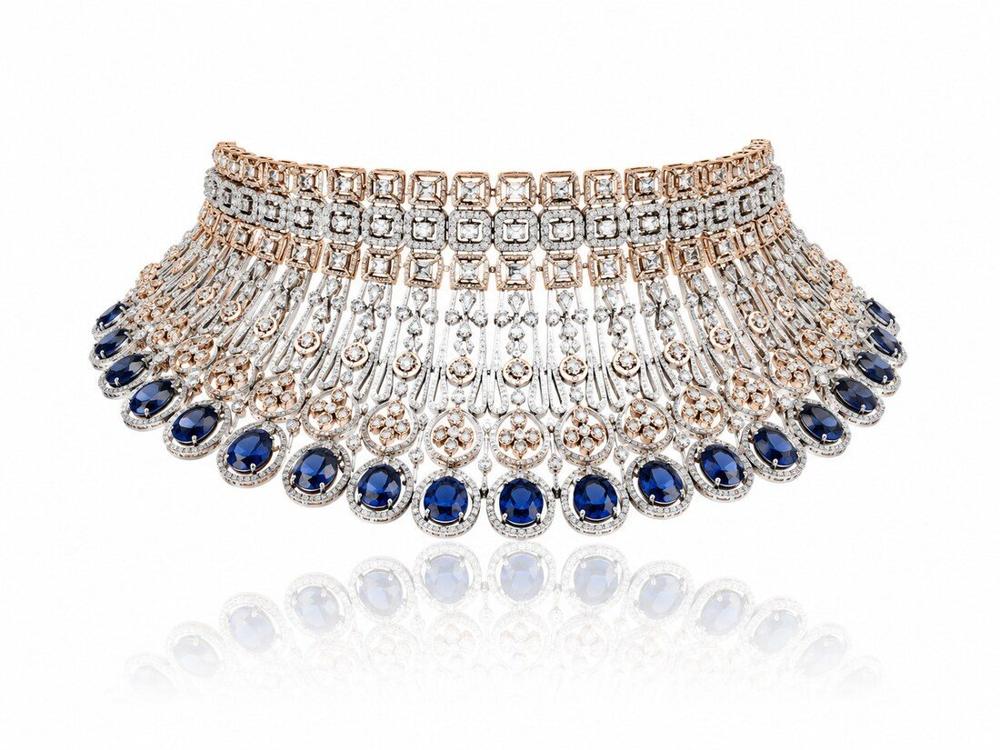
This is a full bib-style choker, a wide plate of diamonds set with natural sapphires scattered through the design rather than confined to a single centre stone. The bib construction covers more of the upper chest than a typical choker, giving it the scale expected of a genuine bridal piece. Natural sapphires bring real depth of blue that stays consistent under any lighting, unlike some treated stones that shift colour indoors versus out. Built specifically with bridal and reception wear in mind, where the neckline is often the focal point of the entire outfit.
Price on request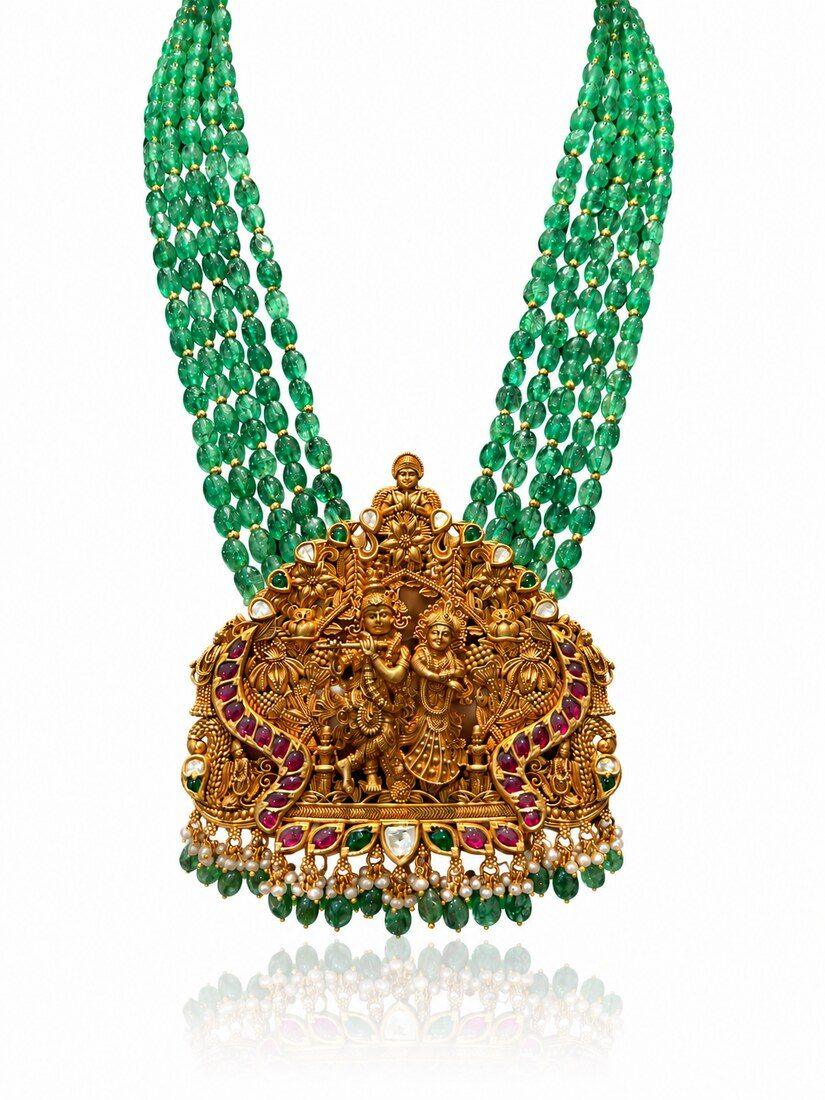
Multiple strands of emerald-green beads fall from the neck in this haram, gathered beneath a carved gold pendant finished in nakshi work. Nakshi refers to the fine relief carving on the pendant's surface, a technique that takes considerably longer than plain polished gold because every detail is worked by hand. The beads are hand-strung rather than machine-threaded, so the strand lengths sit naturally rather than uniformly. As a haram, it's designed to sit lower than a standard necklace, layering well over other jewellery. A natural fit for festive occasions and temple visits where traditional gold is expected.
Price on request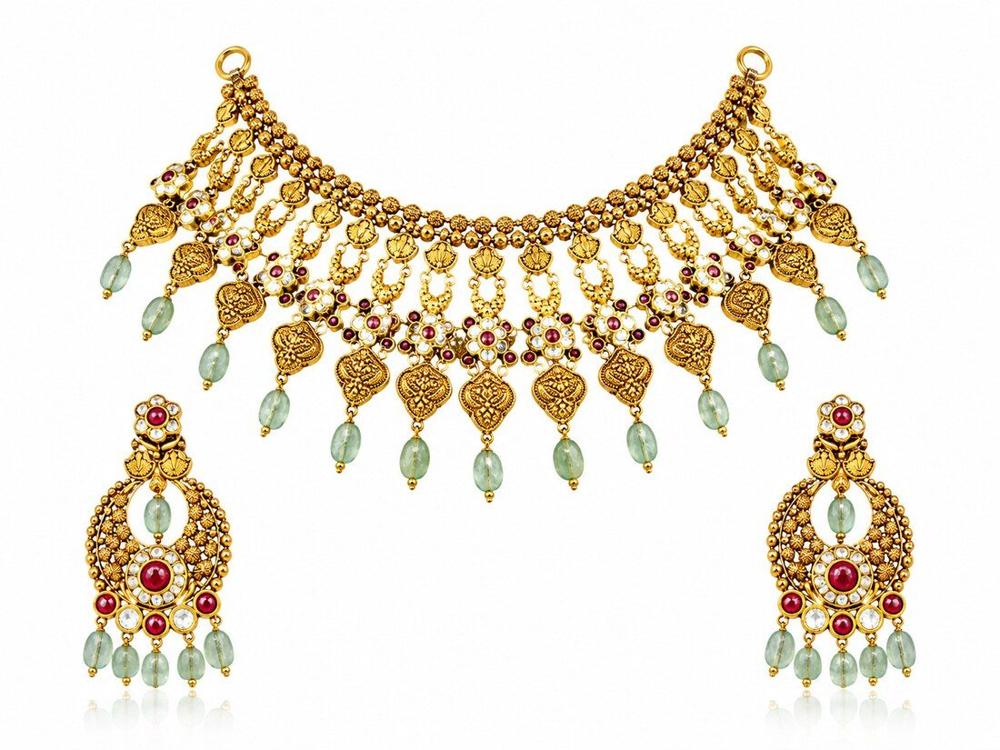
Tiny jhumkis — the classic dome-shaped bell earrings — hang in a fringe along the bottom edge of this gold choker, with small green highlights worked in between. Each jhumki in the fringe is hand-finished individually rather than cast as a single connected piece, so they move independently and catch light at slightly different times as you walk. The choker sits high on the neck, letting the jhumki fringe do most of the visual work below it. Traditionally worn for weddings and festive functions, where its movement and sound are as much a part of the design as its appearance.
Price on request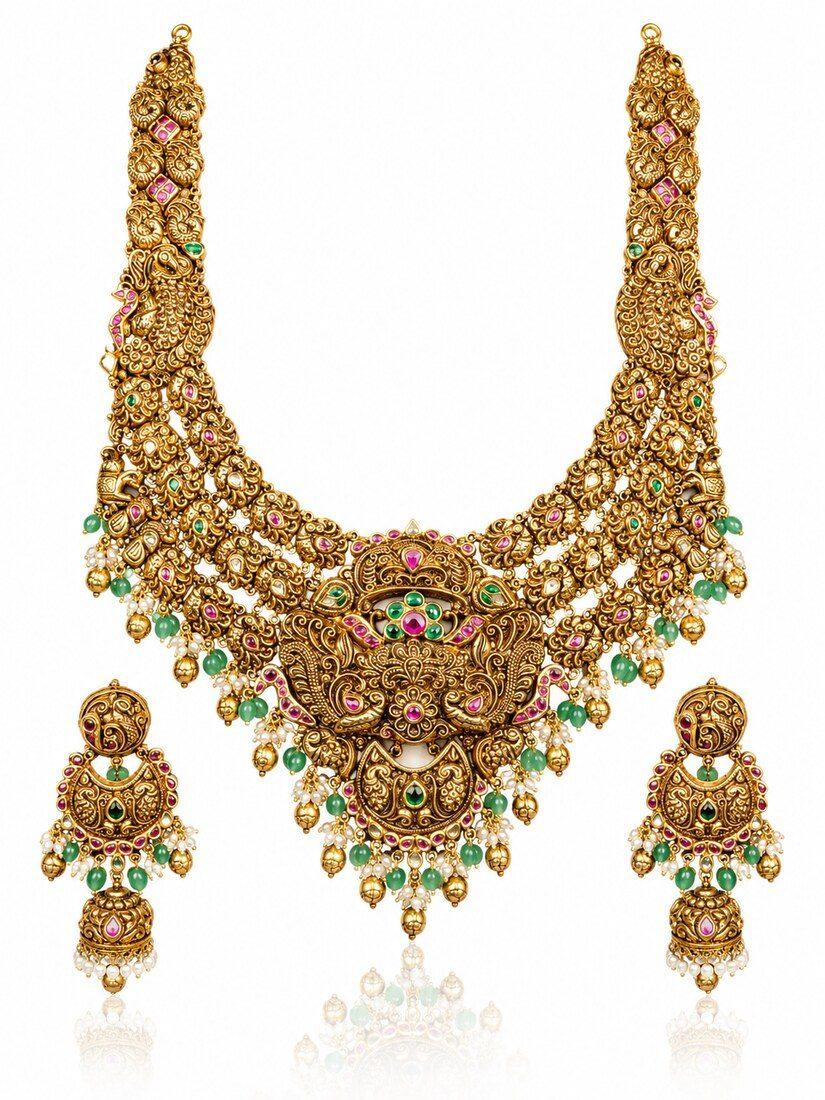
Layered in the antique style, this haram is worked entirely in deep, matte-finished gold rather than the high-polish look of more contemporary pieces. Antique finishing involves deliberately darkening the recesses of the carved pattern so the relief work reads more clearly, a nakshi technique passed down through generations of goldsmiths rather than something that can be replicated quickly. Multiple tiers give it real bridal scale, meant to be worn as a statement piece rather than paired with much else. Built specifically for bridal wear, where its weight and finish carry the formality the day calls for.
Price on request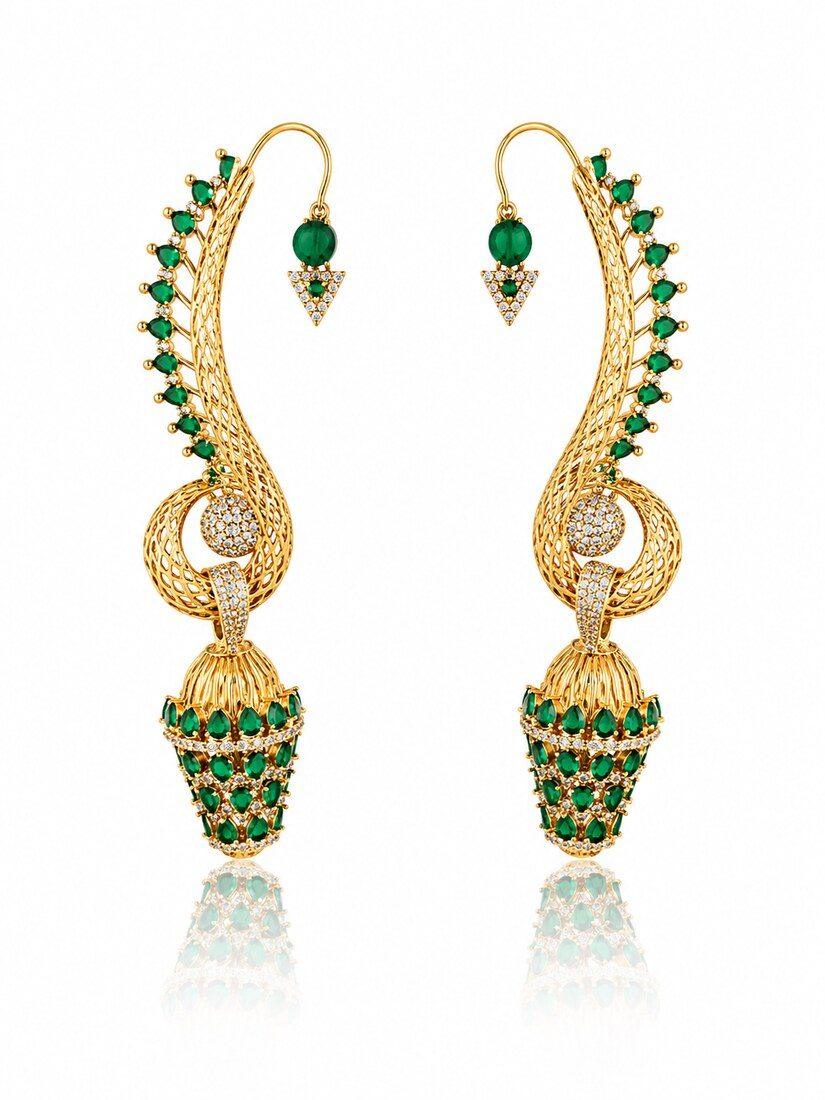
These danglers hook over the ear and drop into a classic jhumka bell shape, hand-carved with green stone accents worked into the gold surface. The hook style keeps the earring secure without a heavy back closure, which matters given the jhumka's weight sits mostly below the earlobe. Hand-carving means the surface pattern has slight variation from one earring to the other, rather than being identically stamped. A reliable festive-wear choice for anyone who wants the traditional jhumka silhouette without an elaborate matching necklace.
Price on request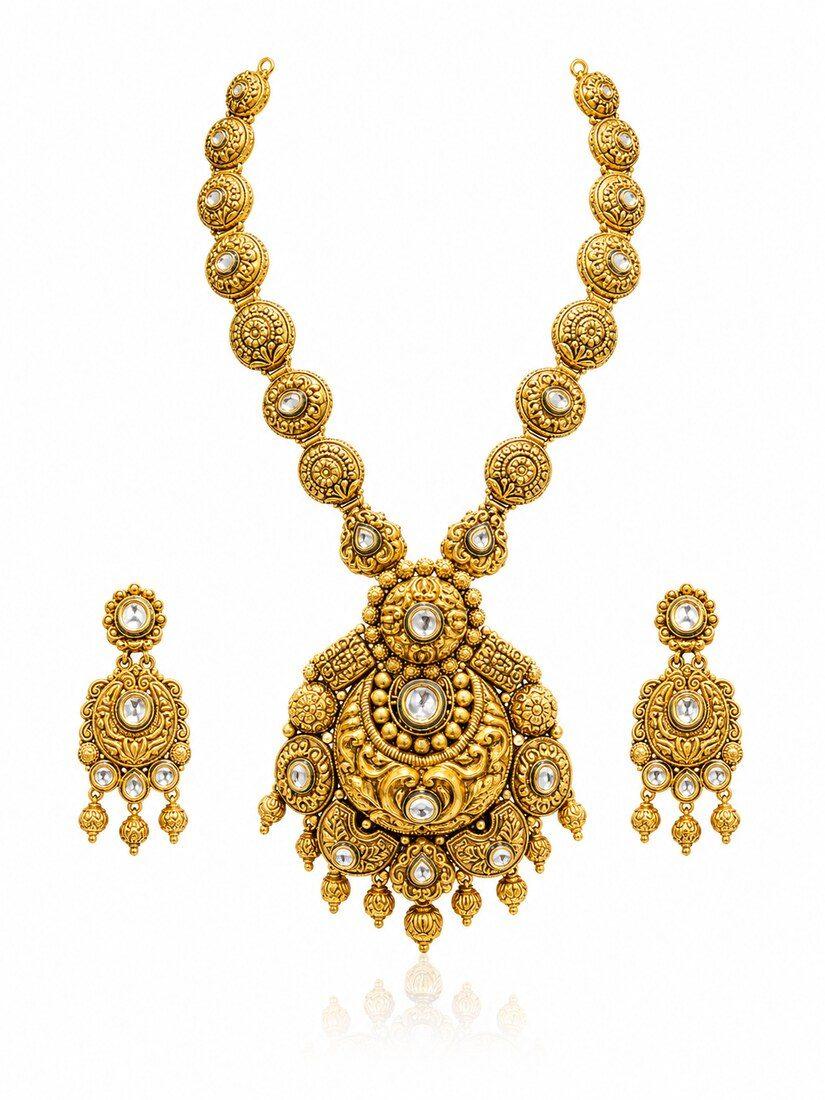
A simple gold chain carries a single floral pendant here, its petals hand-engraved rather than left plain. It's a quieter piece than most of the catalogue, built for daily wear rather than festive occasions, which is reflected in the lighter chain and smaller pendant scale. The engraving catches light subtly rather than throwing it, so the pendant reads as detailed up close without being showy from a distance. A good starting piece if you're building a gold collection from something wearable every day rather than saved for special occasions.
Price on request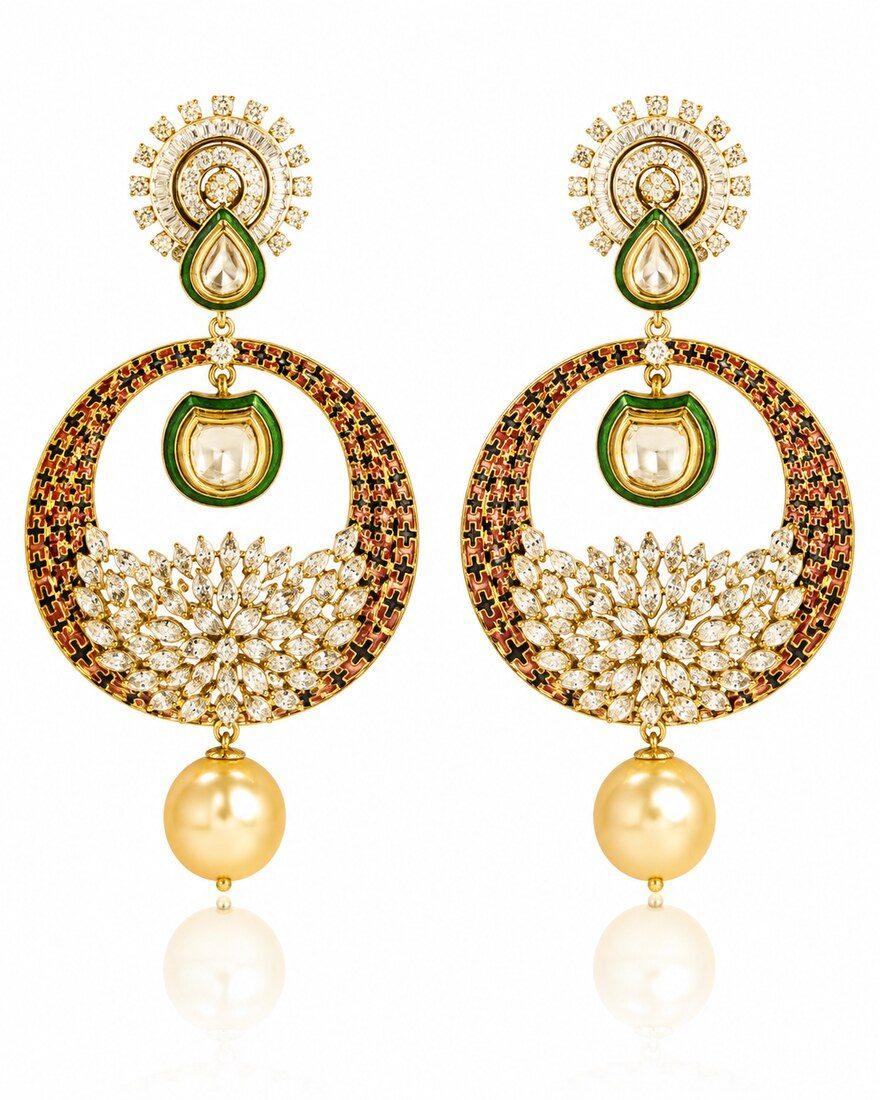
Shaped in the traditional crescent chandbali silhouette, these earrings are edged with small pearls and finished with pearl drops at the base. The chandbali shape — named for its resemblance to a crescent moon — has stayed a wedding and festive staple for generations, and this version keeps that traditional silhouette rather than a modernized reinterpretation. Pearls soften the look against the gold, giving it a slightly quieter finish than an all-stone chandbali. Suited to festive functions and weddings where traditional gold jewellery is the expected choice.
Price on request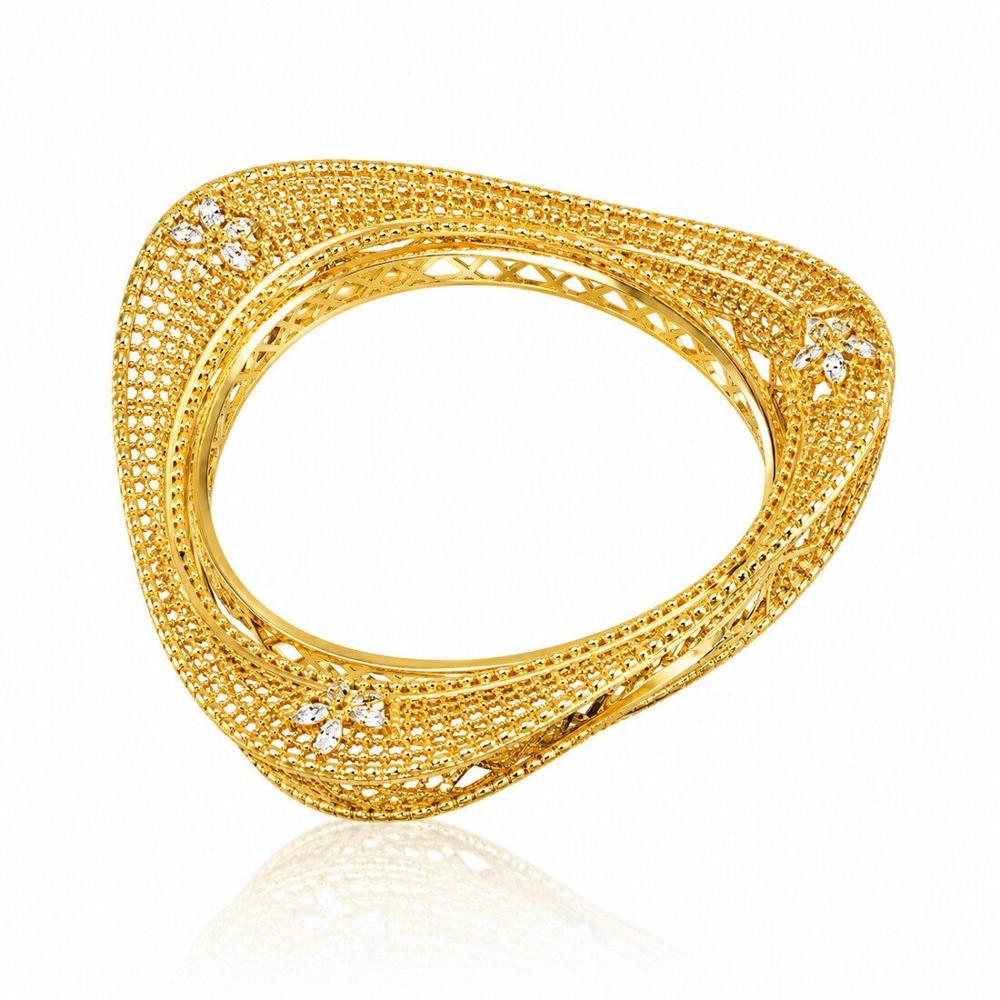
This kada is left deliberately textured, its satin finish catching light without the mirror shine of a polished bangle. Satin finishing is done by lightly abrading the gold surface, which also makes the kada more forgiving of everyday scratches than a high-polish piece would be. Bold and simple in shape, it's built for a man's wrist and works equally for daily wear and festive occasions without needing to be swapped out. The texture also means it pairs comfortably with other bangles without competing for shine.
Price on request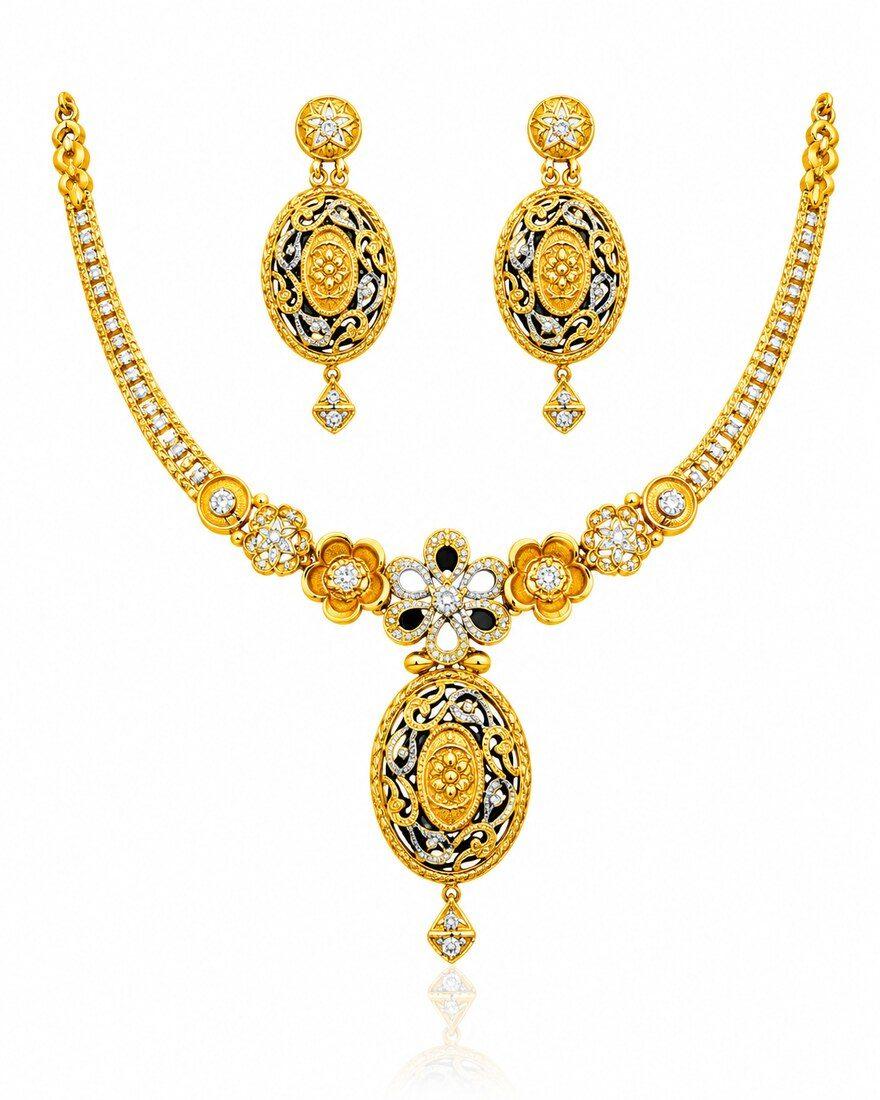
A graceful necklace with a single gold drop at its centre, paired with matching earrings, this set keeps to a classic, high-polish finish without added stonework. Its simplicity is deliberate — this is the kind of set that's often chosen as a gift precisely because it doesn't compete with an outfit or occasion the way a more elaborate piece might. The drop pendant gives it just enough presence to feel finished rather than plain. Equally suited to daily wear or as a first-gold gift for a milestone occasion.
Price on request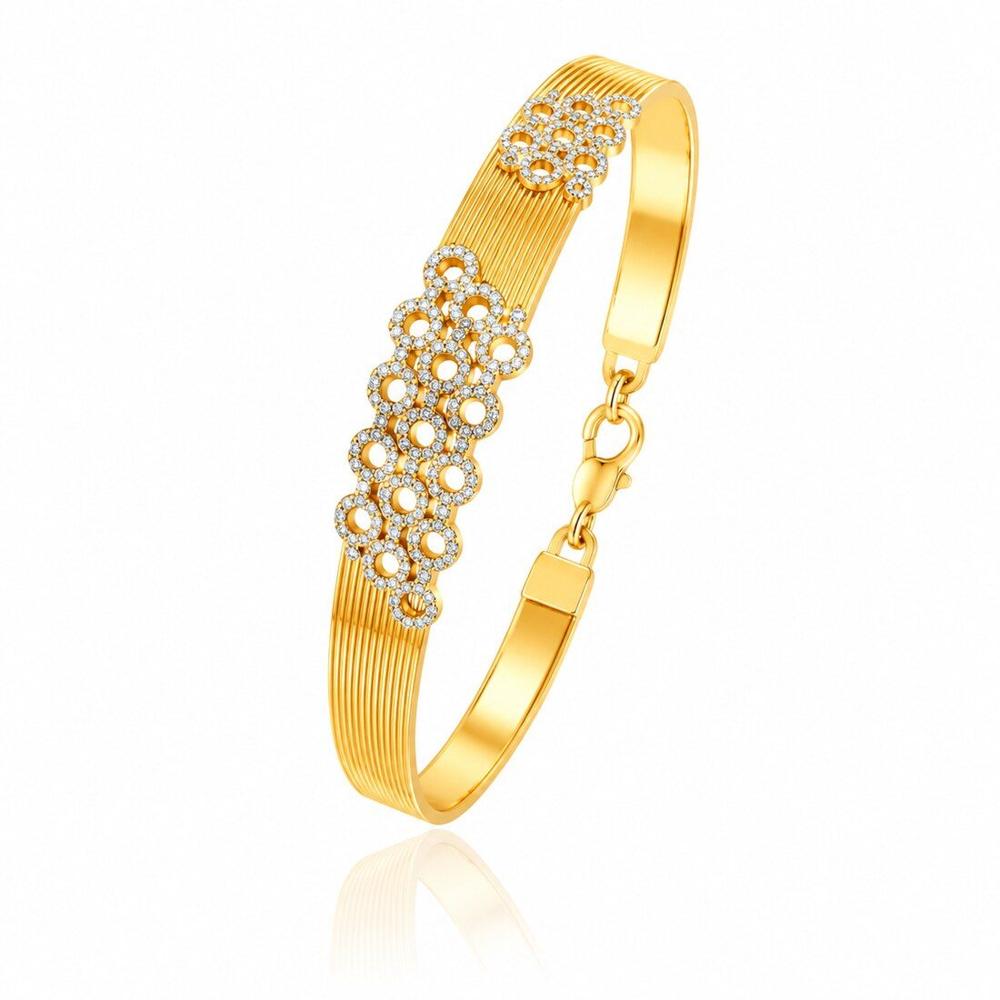
A slim gold bracelet brightened with a scattering of bezel-set diamonds, this piece is built for daily wear rather than special occasions. Bezel setting surrounds each diamond in a thin rim of metal rather than exposed prongs, which protects the stone from daily knocks and makes the bracelet more practical to wear without much thought. The diamonds are spaced rather than clustered, so the gold itself still reads as the main material. A comfortable, low-maintenance piece for anyone who wants a little sparkle without a statement bracelet's upkeep.
Price on request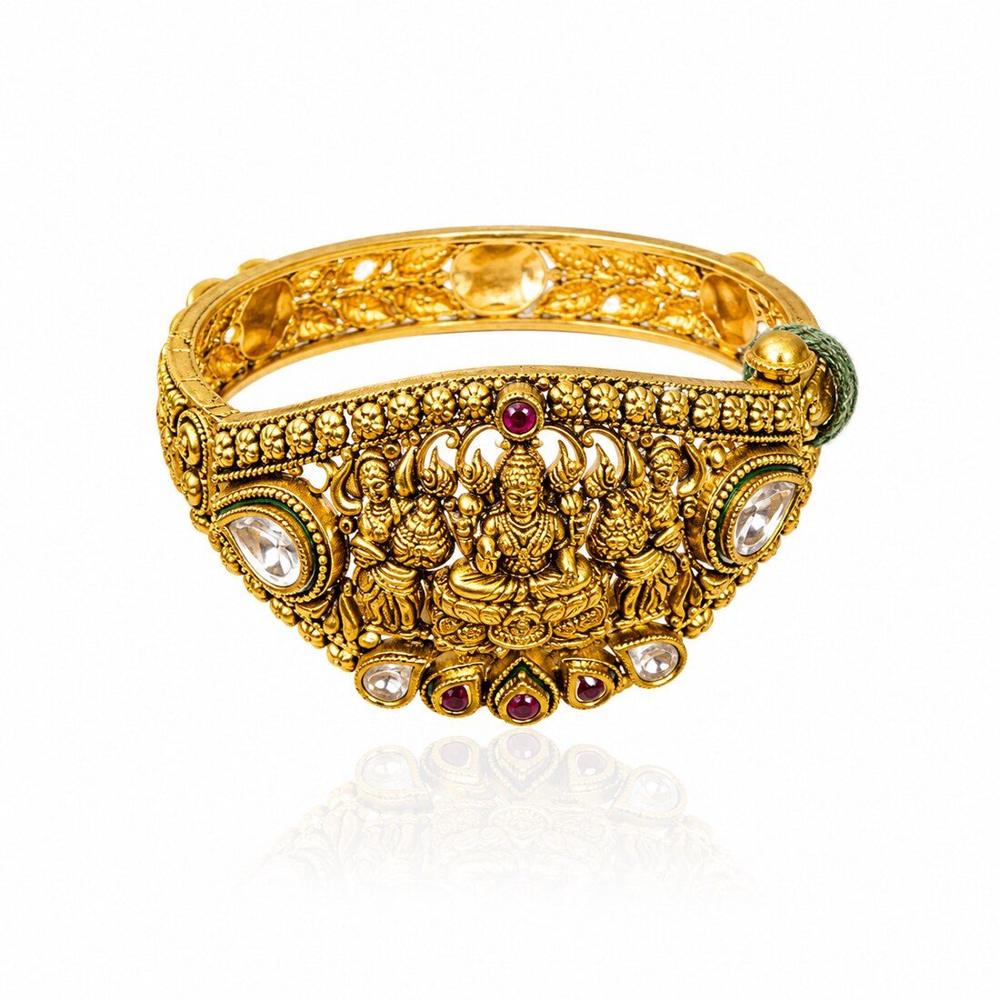
Openwork carving runs the full width of this broad bangle, the gold cut through in a flowing pattern rather than left as a solid band. Openwork takes longer to execute than solid carving since the goldsmith is removing material rather than just marking its surface, and the result is a bangle that's lighter on the wrist than its width would suggest. The pierced pattern also lets the bangle move and catch light differently than a solid surface would. A festive-wear piece with enough presence to wear on its own.
Price on request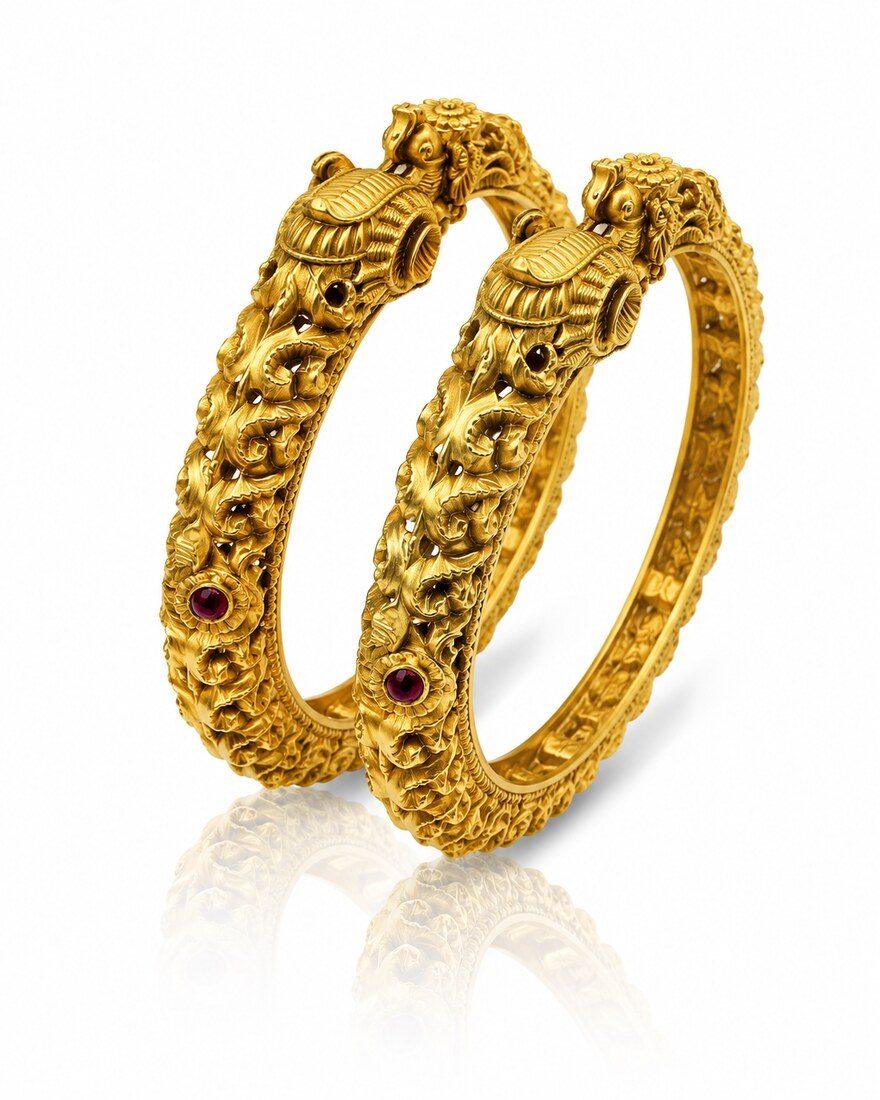
This pair of kadas is carved in deep, heritage-style patterns and finished with the darkened antique look that lets the relief carving stand out clearly. Worked as a pair rather than a single kada, they're designed to be worn together on the same or opposite wrists, which is traditional for wedding and festive dress. The antique hand-carving technique is slower than plain casting, since the darkening process has to be done carefully around each carved detail without muddying the pattern. Built with real wedding-day weight and presence in mind.
Price on request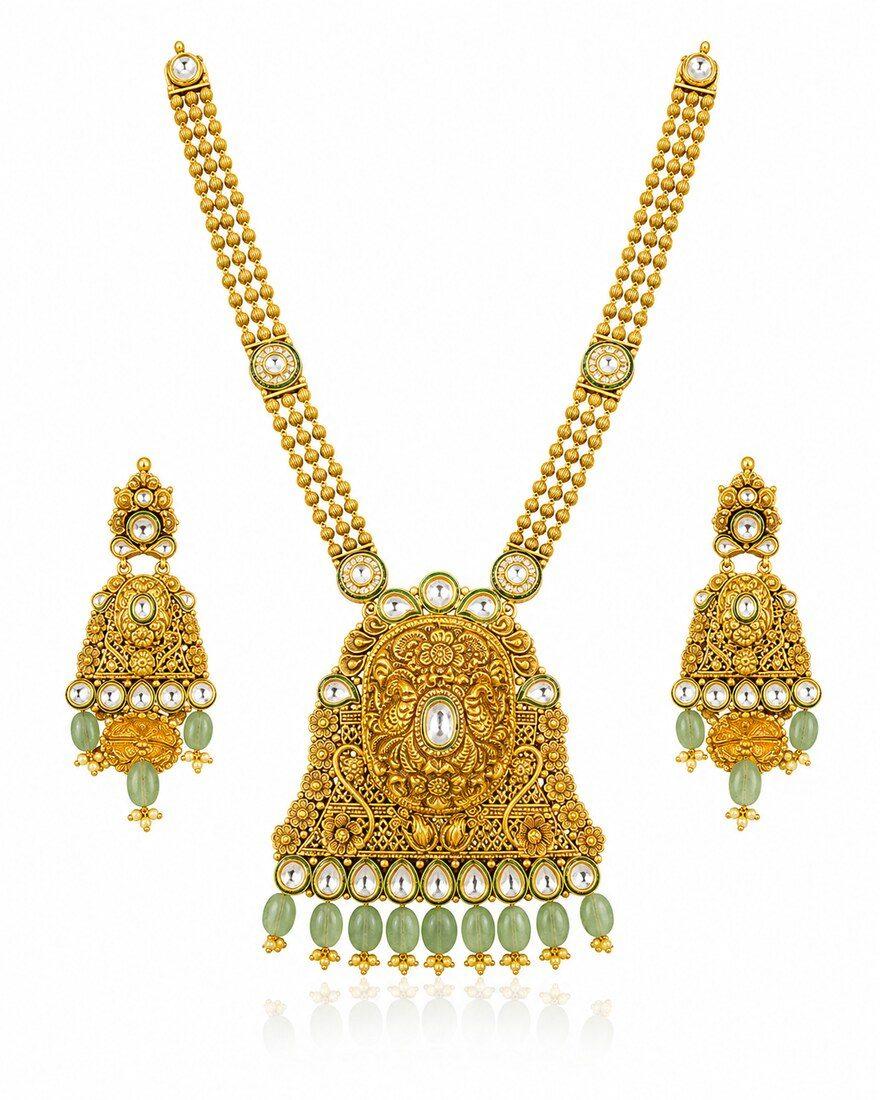
This haram pairs a temple-style pendant with a matching set of jhumka earrings, all worked in the temple jewellery tradition associated with South Indian goldsmithing. Temple craftsmanship typically favours dense, figural motifs over open filigree, and that density is what gives the haram its substantial, formal look. Worn lower than a standard necklace, it layers naturally with a choker underneath for a fuller bridal neckline. Suited equally to bridal wear and temple visits, where this style of gold jewellery carries specific traditional significance.
Price on request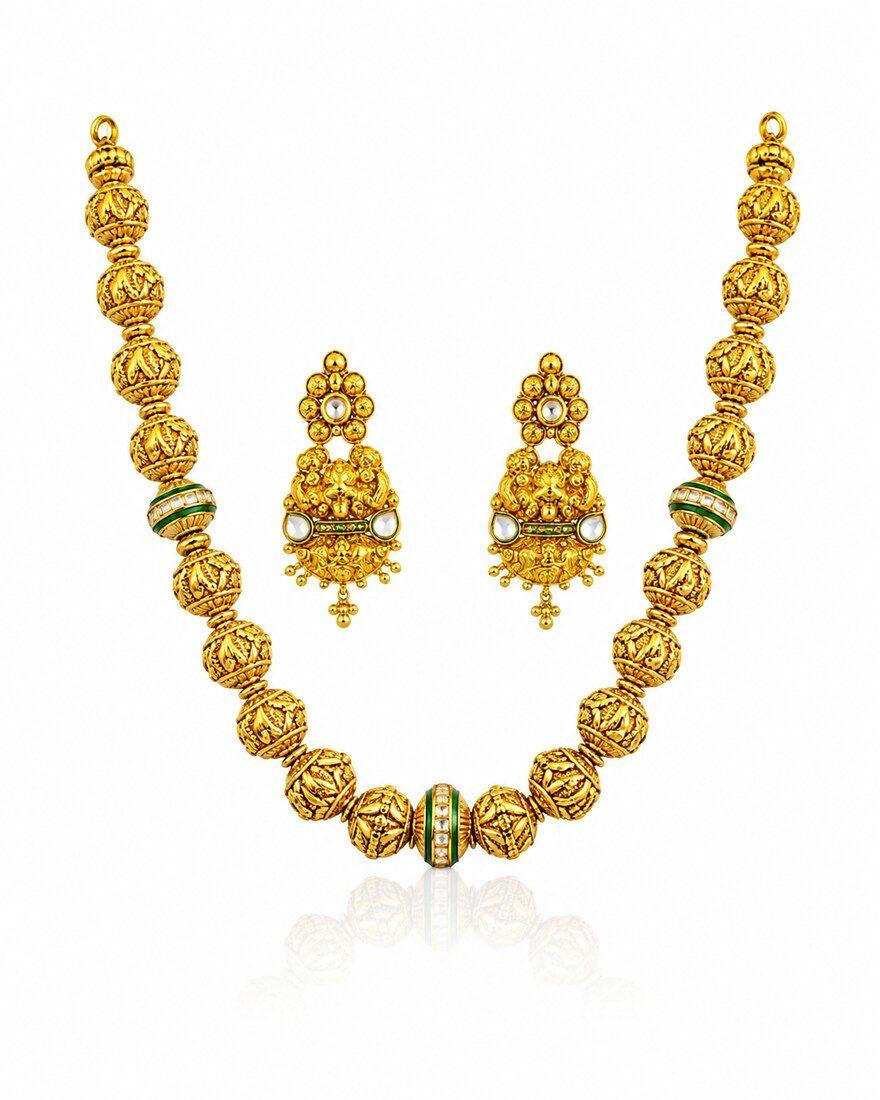
Hand-strung gold beads make up this necklace, paired with delicate matching earrings that echo the same bead shape at a smaller scale. Hand-stringing means the beads sit with tiny natural gaps rather than machine-uniform spacing, which gives the strand a slightly more relaxed drape around the neck. It's a versatile set — plain enough for daily wear, but with enough gold weight to hold its own at festive gatherings too. A practical choice if you want one set that can move between an ordinary day and a family function without feeling out of place.
Price on request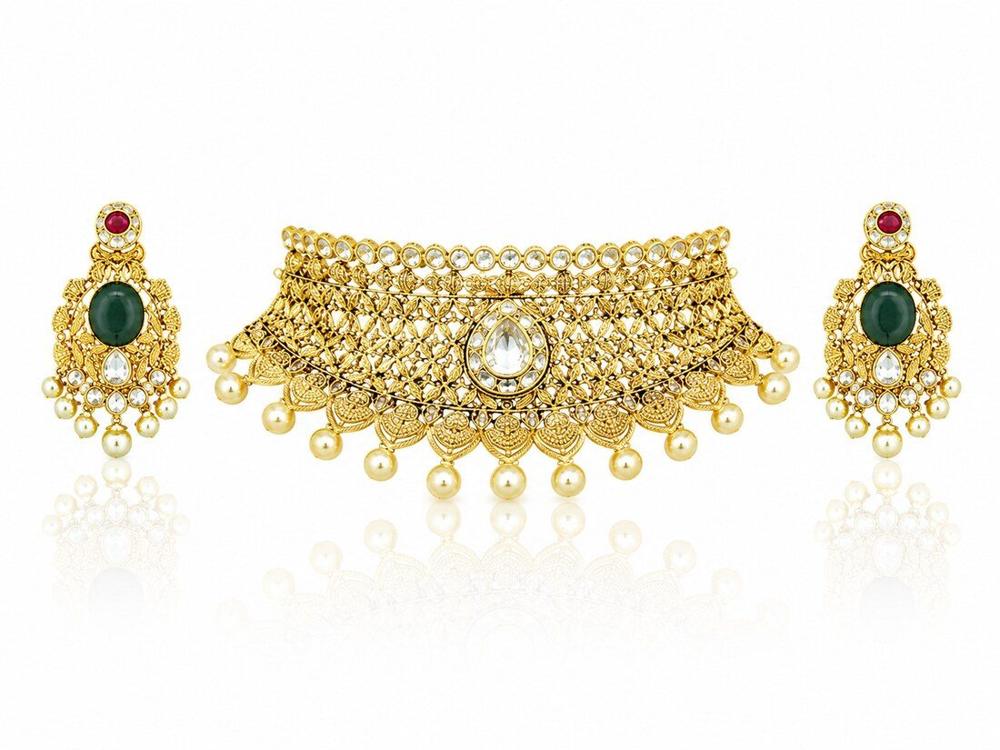
This gold choker set brings together rubies and emeralds in a traditional stone-set pattern, the two colours alternating rather than segregated into separate sections. Mixing red and green stones in gold is a long-standing combination in Indian bridal jewellery, valued as much for the colour contrast as for the individual stones themselves. The choker sits close to the neck, with the set rounded out by earrings finished in the same stone pairing. Designed for weddings and festive occasions where this classic colour combination is exactly what's expected.
Price on request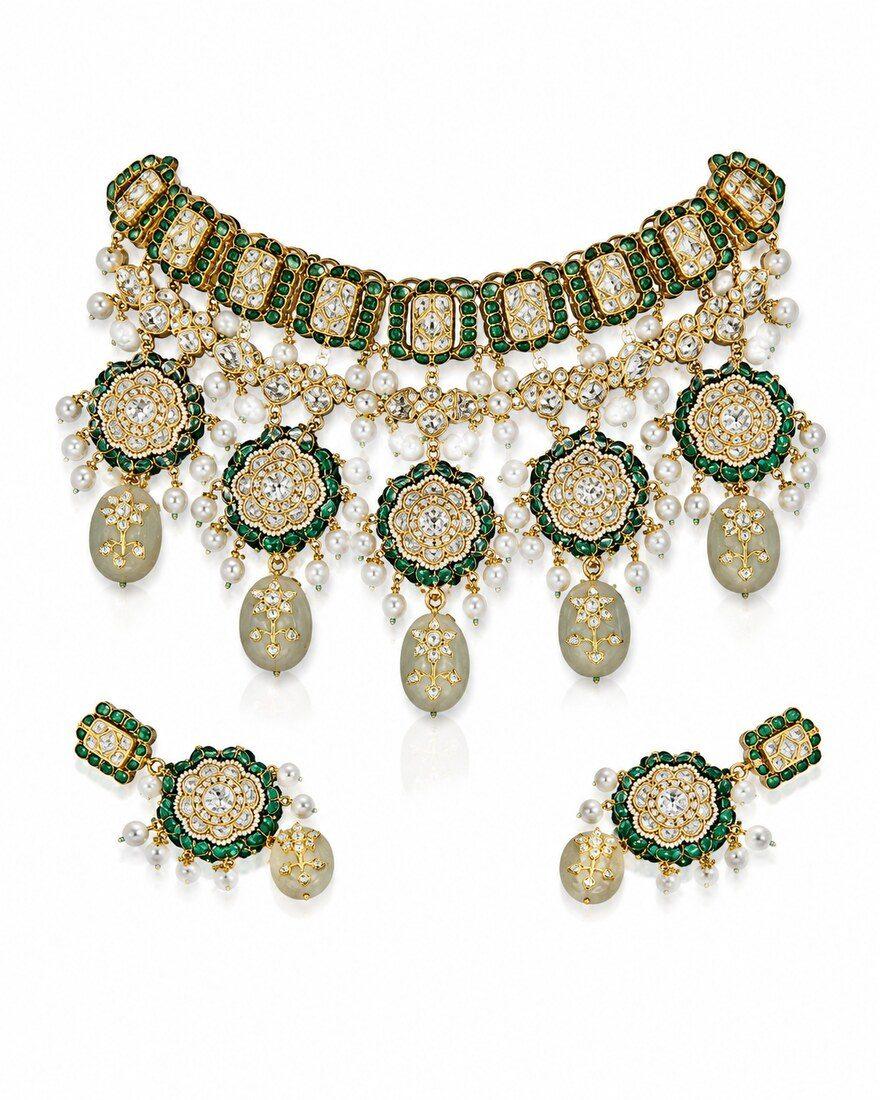
Uncut polki diamonds set the tone for this choker, finished with a run of carved emerald drops along the bottom edge. Polki is set using the jadau technique — stones pressed into a soft gold foil bed rather than claw-set — which is why the diamonds here have that slightly irregular, antique glint rather than the precise sparkle of faceted stones. Jadau setting is entirely hand-done and can't really be replicated by machine, which is part of what keeps polki pieces in demand for bridal wear specifically. The emerald drops add a controlled hit of colour against the mostly-white polki above them.
Price on request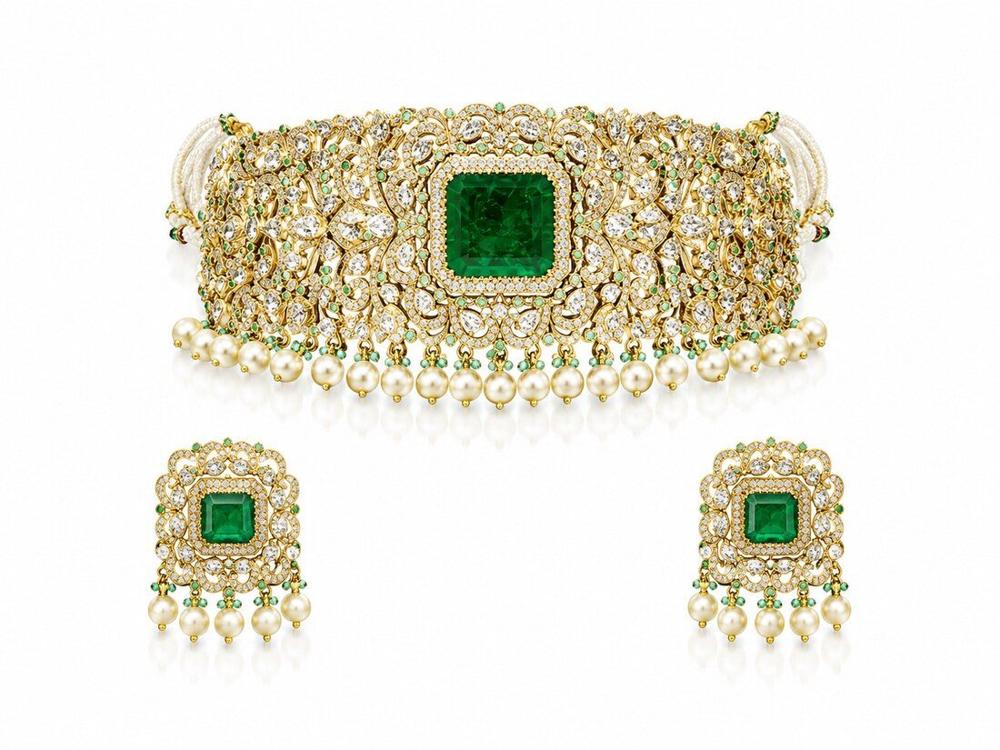
This bracelet combines jadau-set polki with rows of small emerald beads, finished with a matching pair of earrings. As with all jadau work, the polki stones are pressed into gold foil rather than prong-set, giving the bracelet a warmer, less clinical sparkle than a faceted-diamond piece would have. The emerald beads run alongside the polki rather than being scattered through it, keeping the two elements visually distinct. Sized to sit comfortably at the wrist without restricting movement, making it a practical option for festive occasions that involve a full day of wear.
Price on request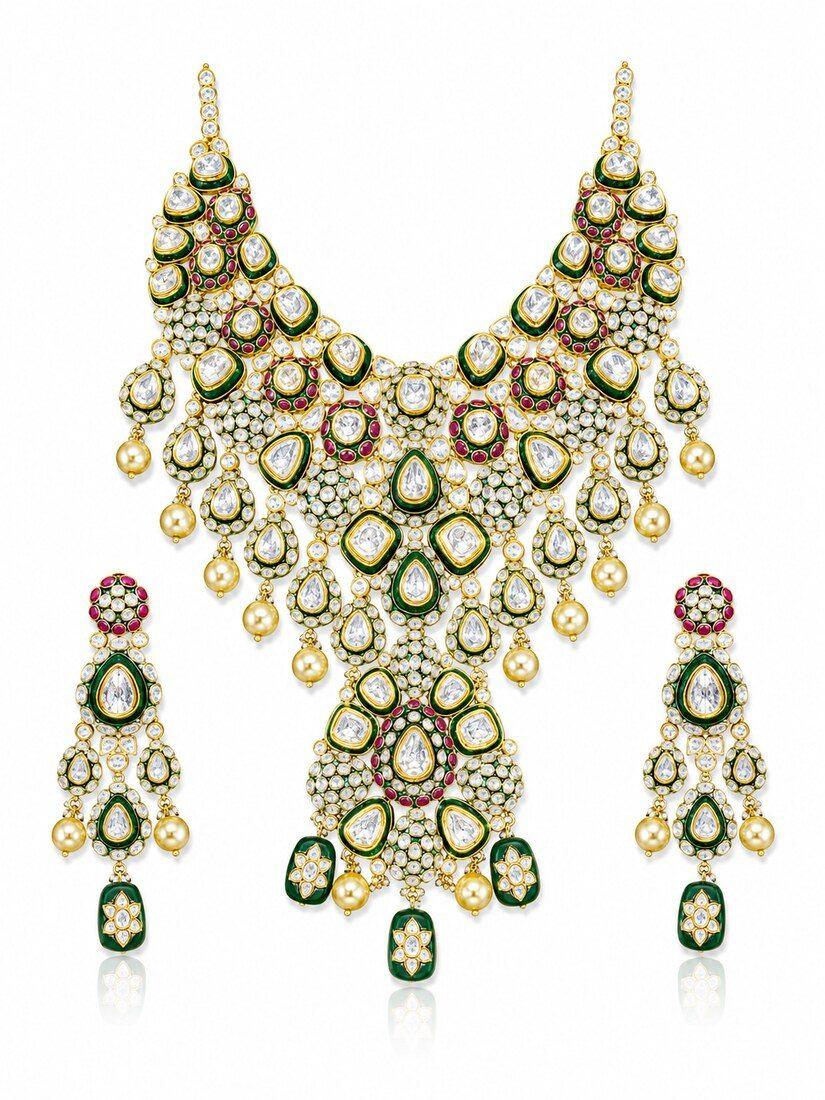
A grand bib of kundan work forms the base of this necklace, with emeralds set through the design for colour. Kundan is closely related to polki but uses a slightly different foil-setting process, generally associated with an even more traditional, layered bridal look. The scale here is deliberately large — this is built as a centrepiece necklace for the wedding day itself rather than a smaller occasion. Kundan craftsmanship of this kind is increasingly rare to find done properly, since it depends on setters trained specifically in the technique rather than standard prong or bezel work.
Price on request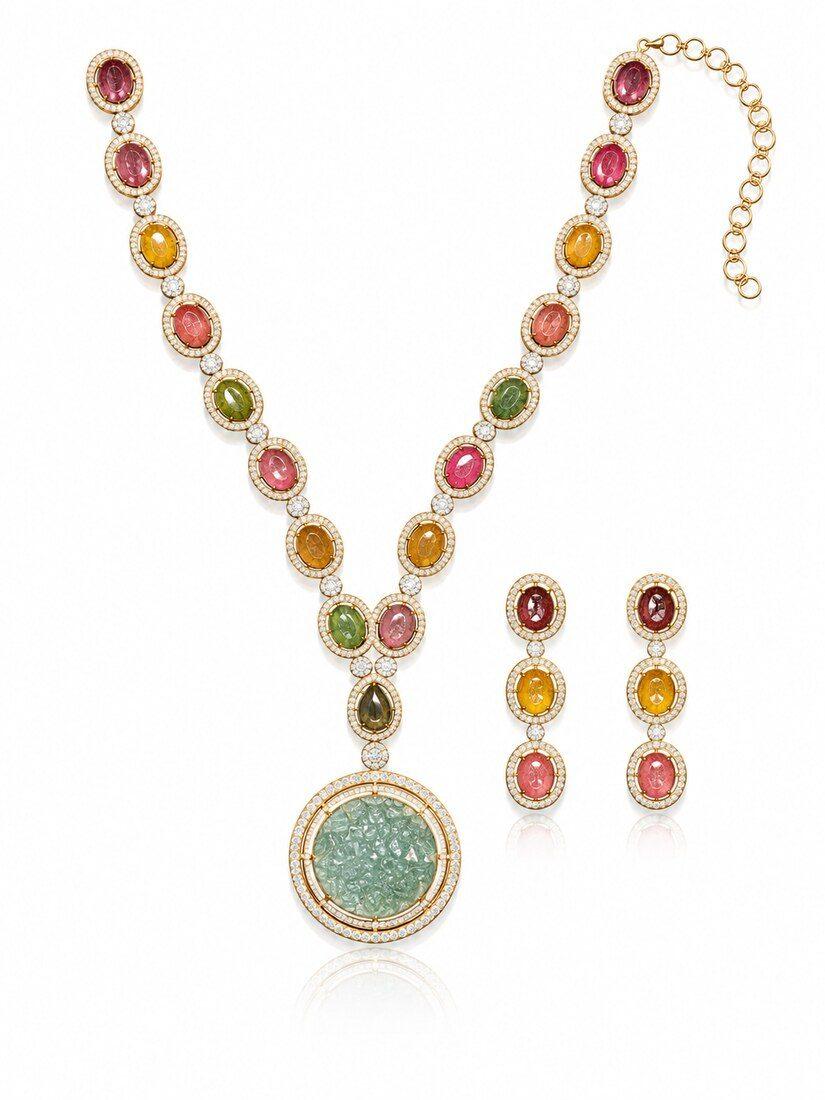
Soft pink and green stones alternate along this mala, hand-strung and finished with a round, carved jade pendant at the centre. A mala sits longer than a standard necklace, often falling below the collarbone, and this one is built with a lighter, more casual palette than the site's typical bridal red-and-gold combinations. The jade pendant is carved rather than left as a plain cabochon, adding detail to what would otherwise be the piece's simplest element. Versatile enough to move between festive functions and regular daily wear, depending on how it's styled.
Price on request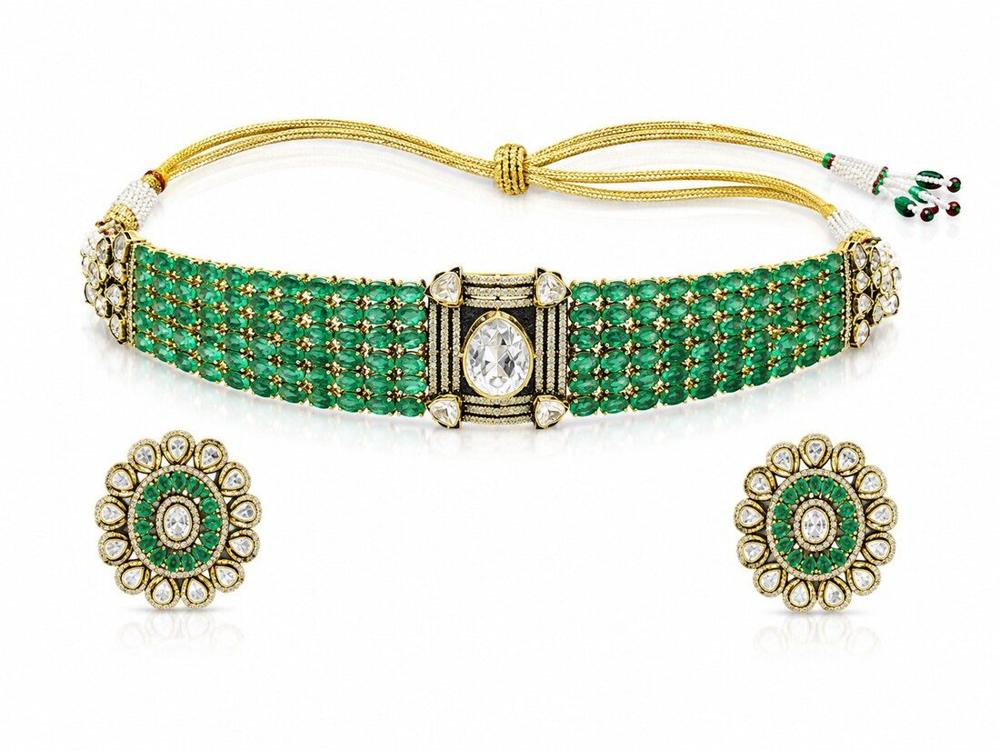
Emerald beads run alongside jadau-set polki in this choker, with a matching bracelet and stud earrings rounding out the full set. Having a coordinated bracelet and earrings alongside the choker means the whole look can be assembled from one set rather than mixing pieces from different collections, which matters for wedding dressing specifically. The emerald beads are strung individually rather than set as flat stones, giving them a slightly different texture from the polki around them. Built for weddings and festive occasions where a complete, matched look is the goal.
Price on request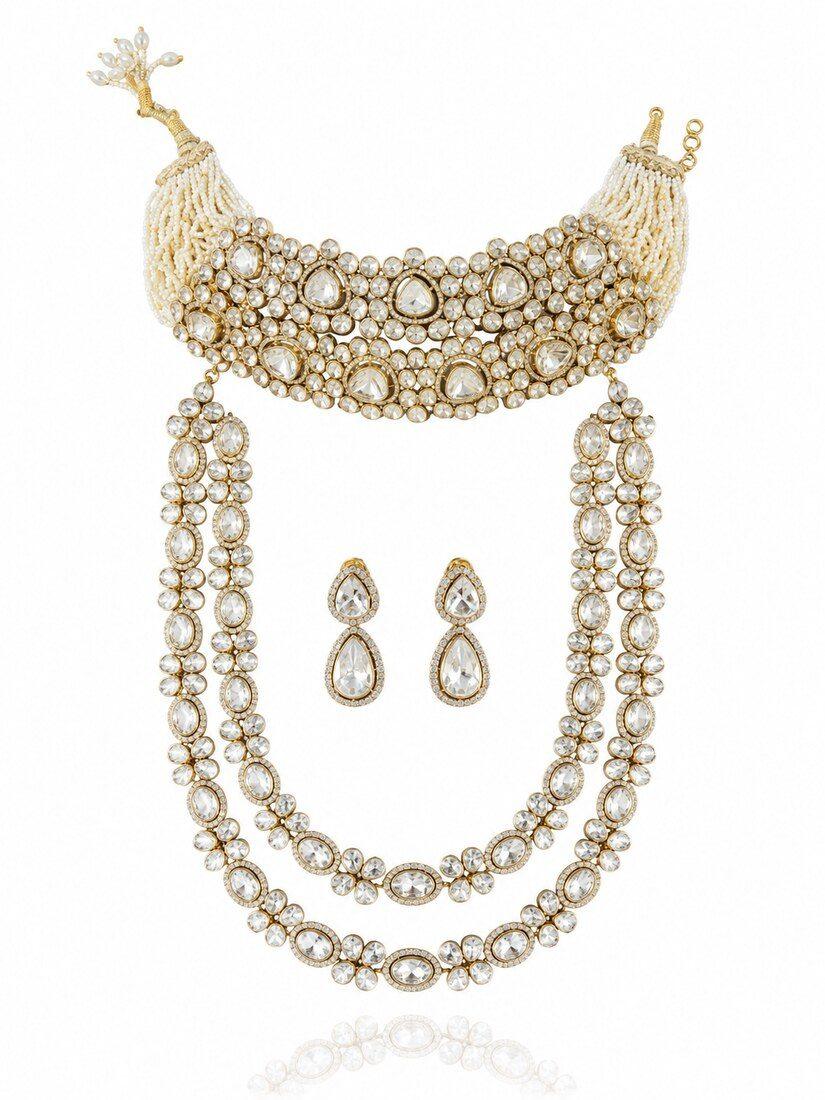
Two full layers of uncut polki make up this choker, hand-set so each tier sits at a slightly different height around the neck. The double-layer construction gives it noticeably more visual weight than a single-tier choker, which is exactly the point for a piece meant to anchor a full bridal look. Because every stone is hand-set into the jadau foil bed, no two polki pieces will be positioned in quite the same way, giving each choker slight individual character despite the repeated design. Built specifically with bridal wear in mind, where scale and presence matter more than restraint.
Price on request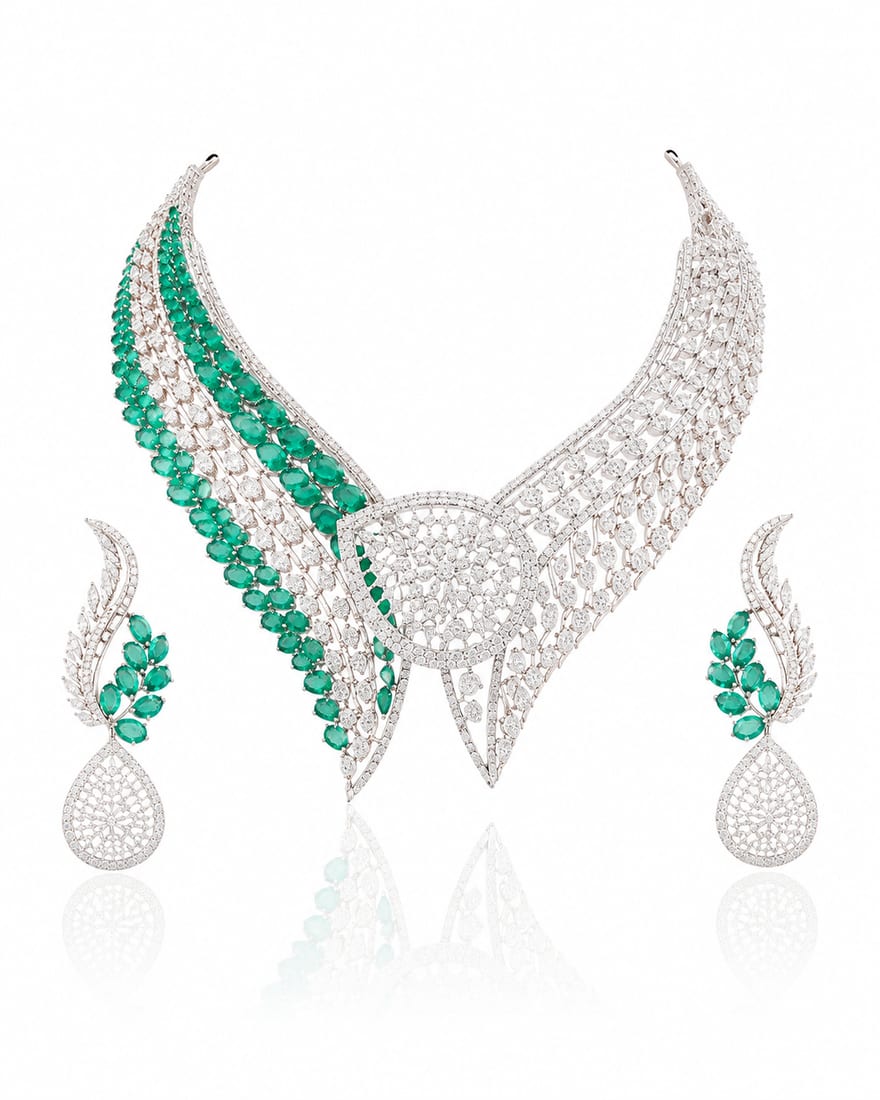
A sculptural diamond collar shapes itself into a pair of wings on this necklace, finished with emerald accents worked along the sweep. Diamond wing motifs are less traditional than a straight collar, giving the design more movement and asymmetry than a typical bib necklace. The emeralds are placed sparingly rather than throughout, so they read as deliberate accents rather than a competing colour story. Set in white gold, the whole piece stays cool-toned and formal. Built for bridal and reception wear where a more sculptural, modern necklace shape is preferred over a traditional bib.
Price on request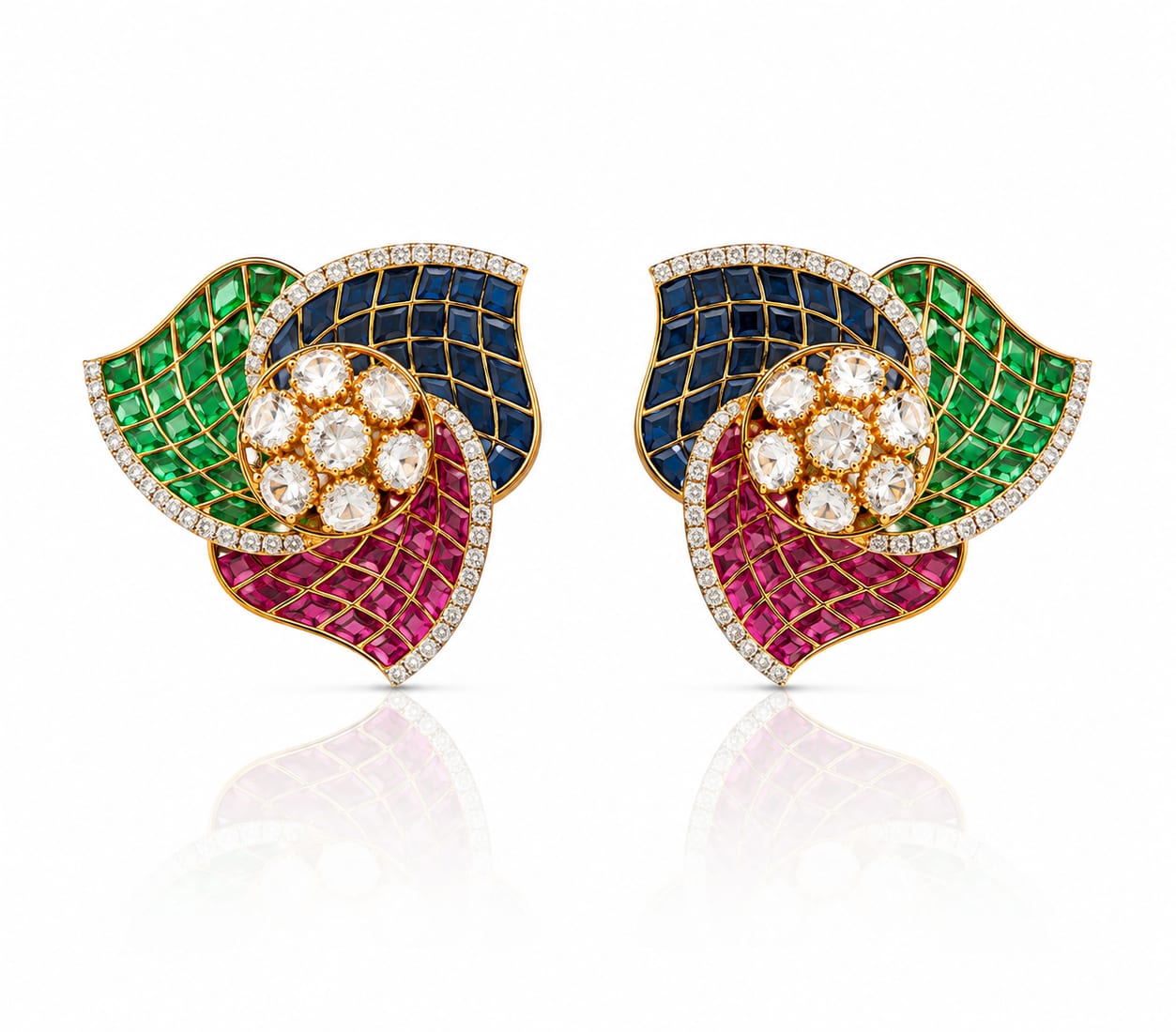
Emerald, sapphire and ruby swirl together in a floral pattern around a diamond centre in these earrings, each colour calibré-cut to fit its petal precisely. Calibré cutting shapes each coloured stone to an exact size and outline before setting, which is more labour-intensive than using pre-cut standard stones but gives the floral pattern its clean, seamless edges. Three colours in one small earring is a bold combination, balanced here by the single diamond centre holding everything together. A cocktail and festive-wear pick for outfits that already lean toward jewel tones.
Price on request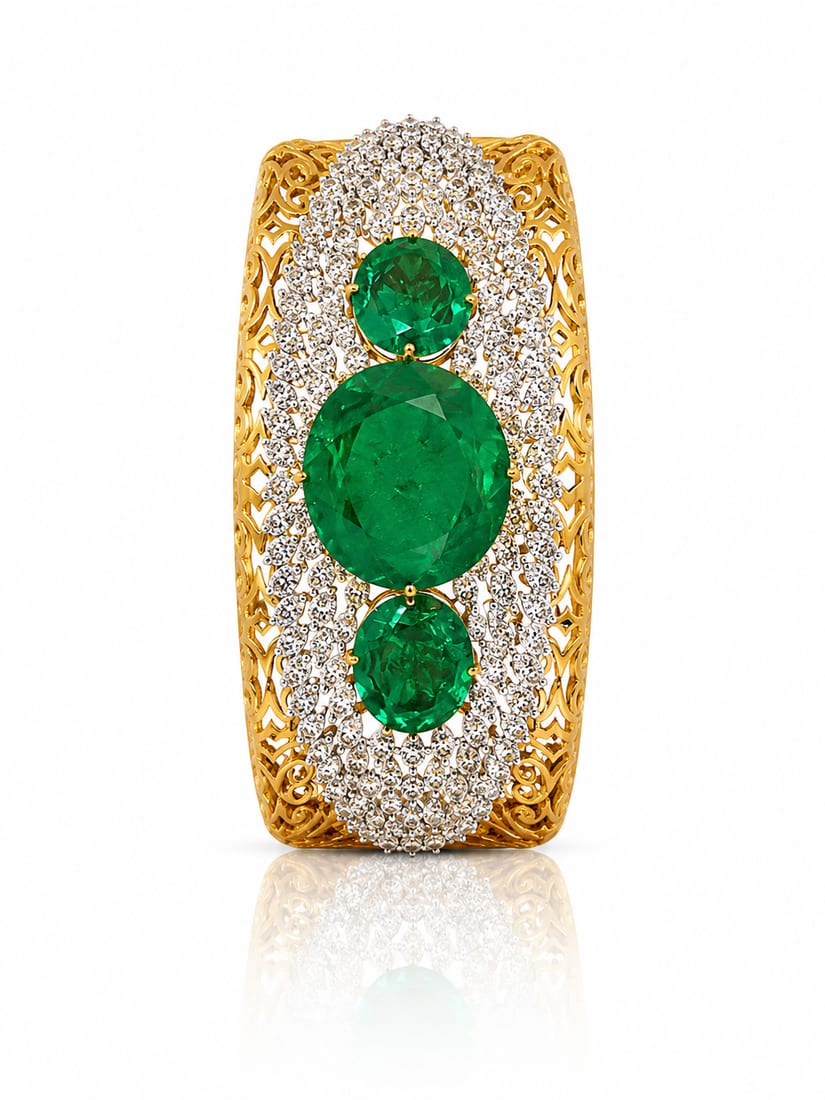
Three graduating emeralds run up the centre of this openwork gold bangle, framed on either side by a lattice of pavé diamonds. The openwork lattice keeps the bangle visually lighter than a solid band of the same width, letting light pass through the design rather than just reflecting off a flat surface. Grading the three emeralds by size, largest at the centre, draws the eye naturally toward the middle of the bangle first. Prong-set rather than bezel-set, the emeralds sit slightly raised for extra depth. Suited to festive and party occasions where a wide bangle needs real visual interest.
Price on request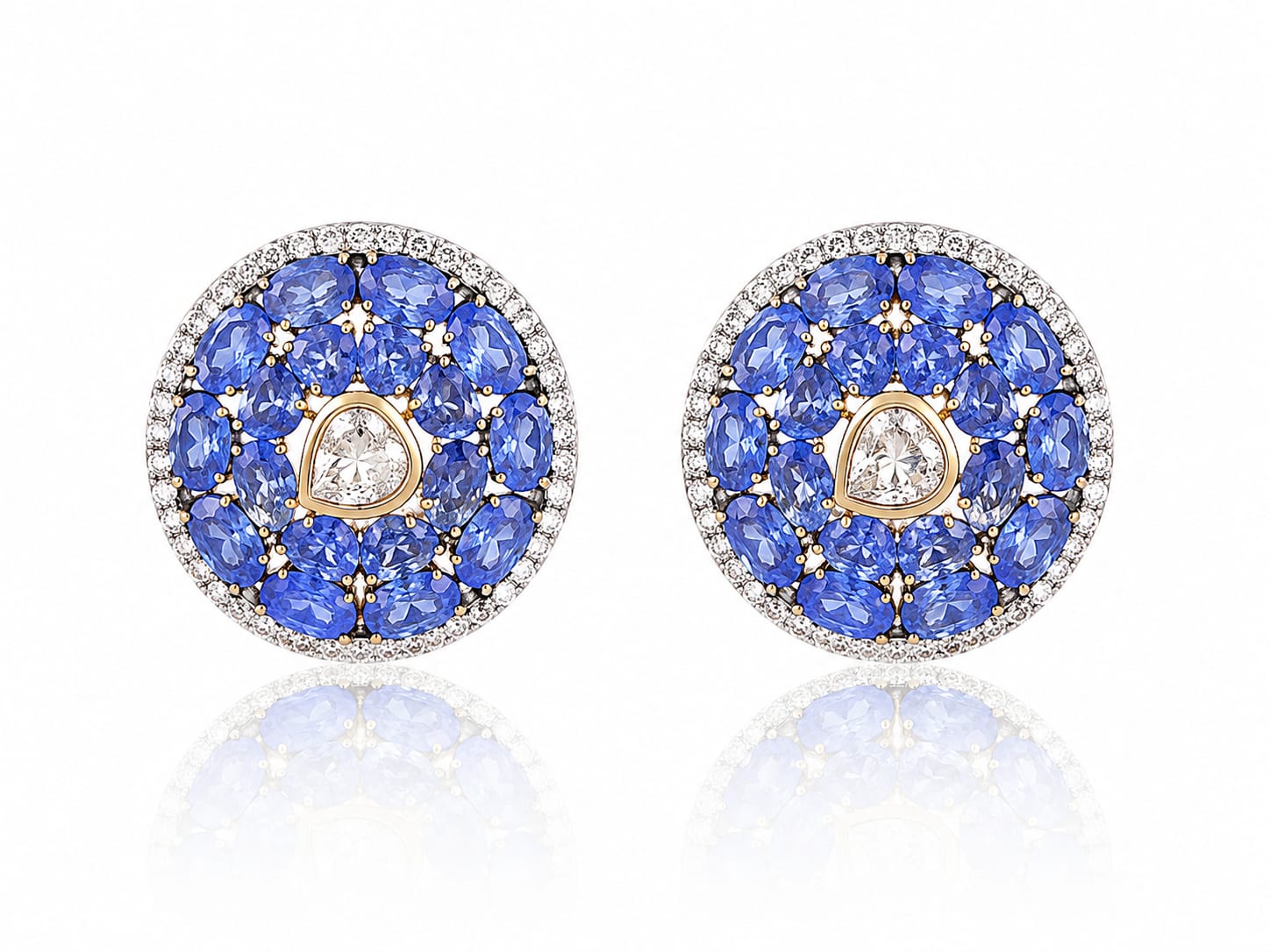
Clusters of blue sapphires gather around a bezel-set diamond centre in these studs, each cluster packed close enough to read as a single field of colour. Bezel-setting the central diamond keeps it flush and protected, which matters for a stud earring worn close to the ear where it can catch on hair or fabric. The surrounding sapphires are smaller and more numerous rather than fewer larger stones, giving the cluster texture instead of flat colour. A dependable evening and party-wear stud when you want blue in the mix without a full sapphire statement piece.
Price on request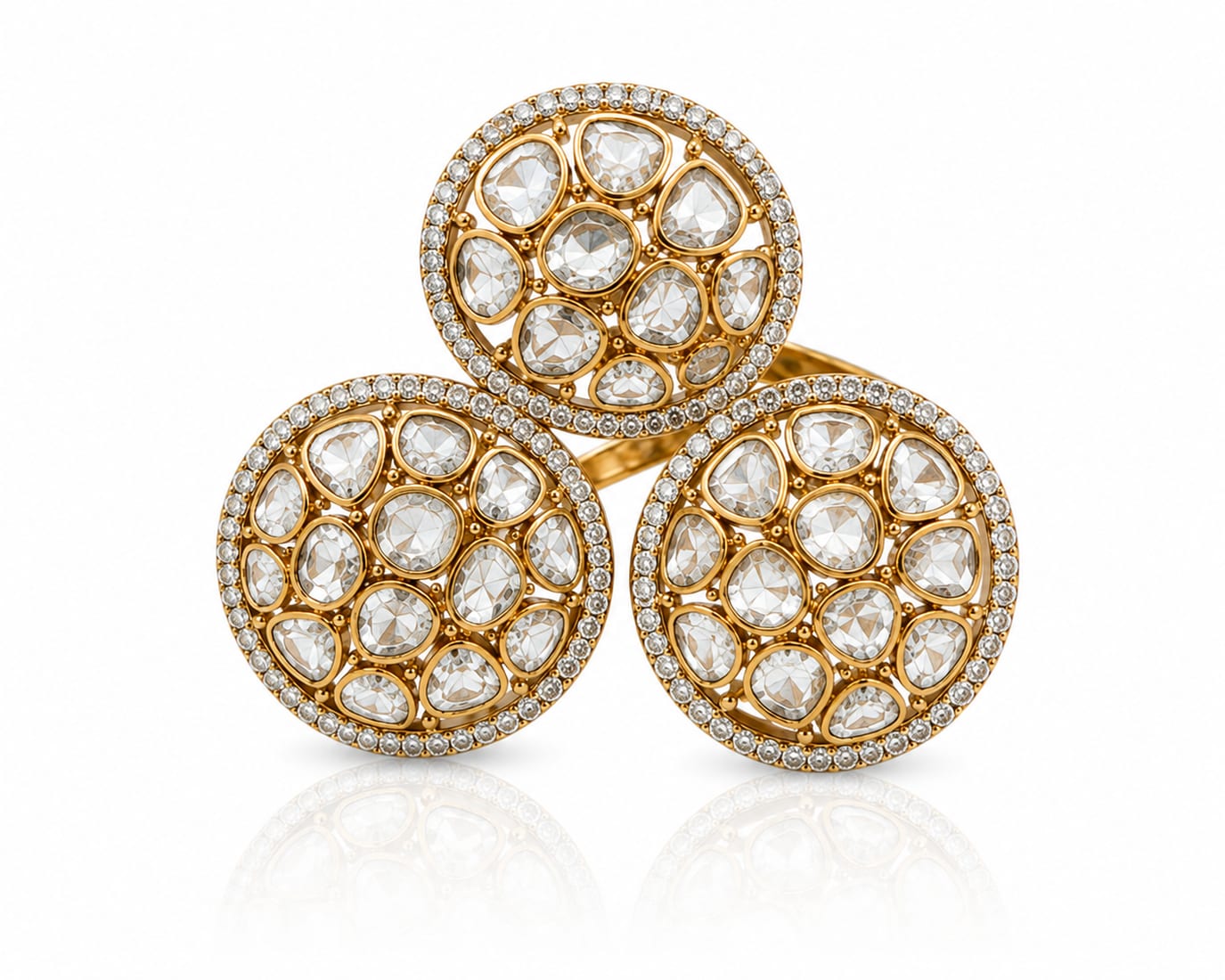
Three domes of rose-cut, uncut diamonds meet at a single point on this ring, each dome edged with its own halo of round brilliants. Rose-cut diamonds are flat on the bottom and faceted on top, giving them a softer, more antique glint compared to the sharper sparkle of standard brilliant cuts. Repeating that cut three times across connected domes is an unusual, architectural take on a cocktail ring rather than a single large centre stone. The halo trim around each dome adds definition without overwhelming the rose-cut texture underneath. Built for cocktail hours and festive evenings where the ring is meant to be the conversation piece.
Price on request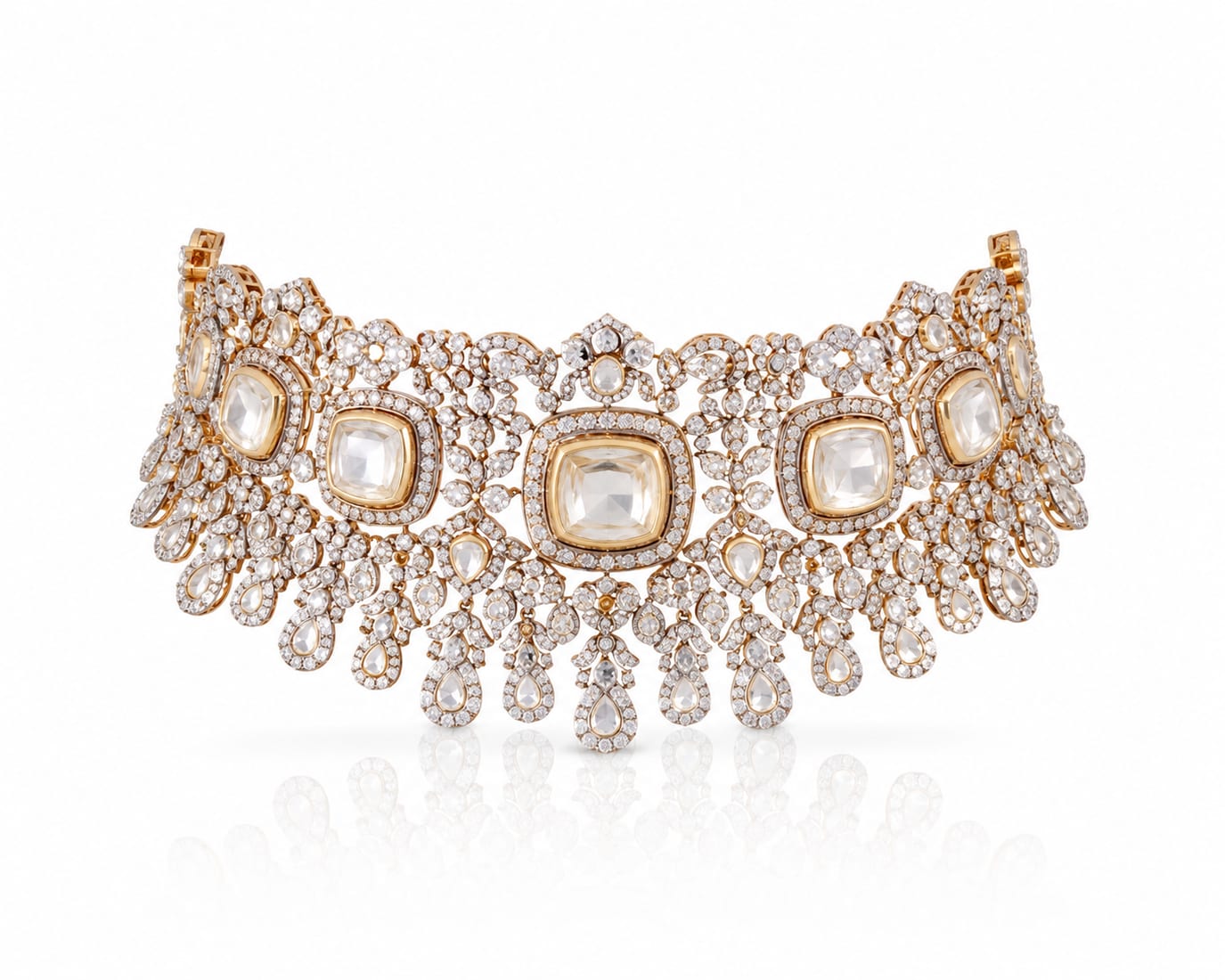
Cushion-cut diamonds are bezel-set across this choker, with a fringe cascading down from the lower edge for movement. Cushion cuts have rounded corners and larger facets than a standard round brilliant, giving each stone a softer, slightly vintage-leaning sparkle. The fringe isn't rigid — individual diamond drops hang loosely enough to shift as you move, adding motion to what would otherwise be a fixed, formal choker. Scaled for a genuine bridal or reception moment, this is a piece built to be the centrepiece of the entire look rather than one part of it.
Price on request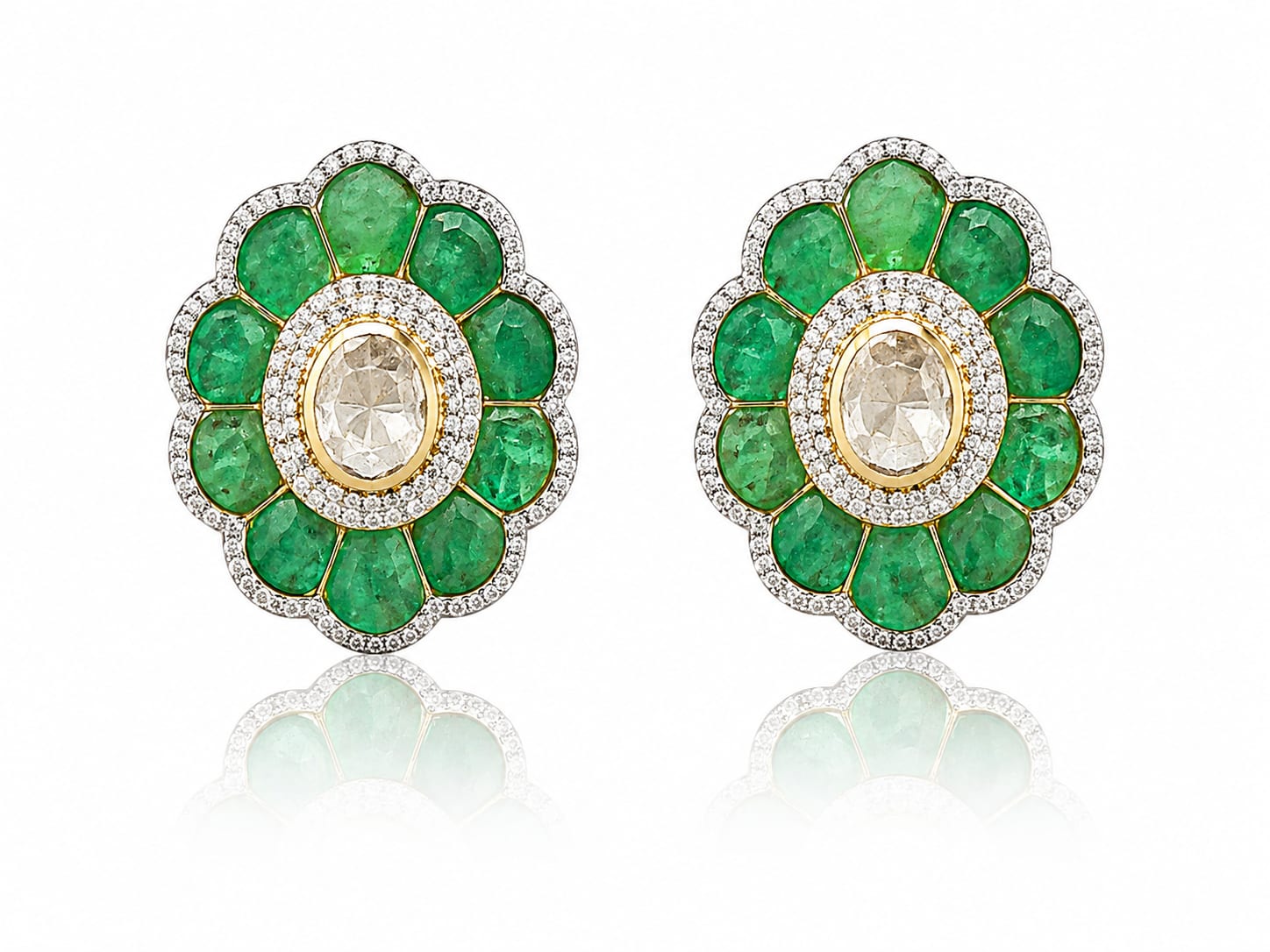
A scalloped ring of emerald petals frames a rose-cut diamond centre in these earrings, the petal-set stones curving around in an unbroken floral outline. Petal setting shapes each emerald individually to follow the flower's curve, rather than using uniform round stones that would leave visible gaps at the edge. The rose-cut diamond at the centre adds a softer glint than a brilliant-cut stone would, keeping the whole earring from feeling too sharp or clinical. A festive and party-wear earring with enough detail to wear with minimal other jewellery.
Price on request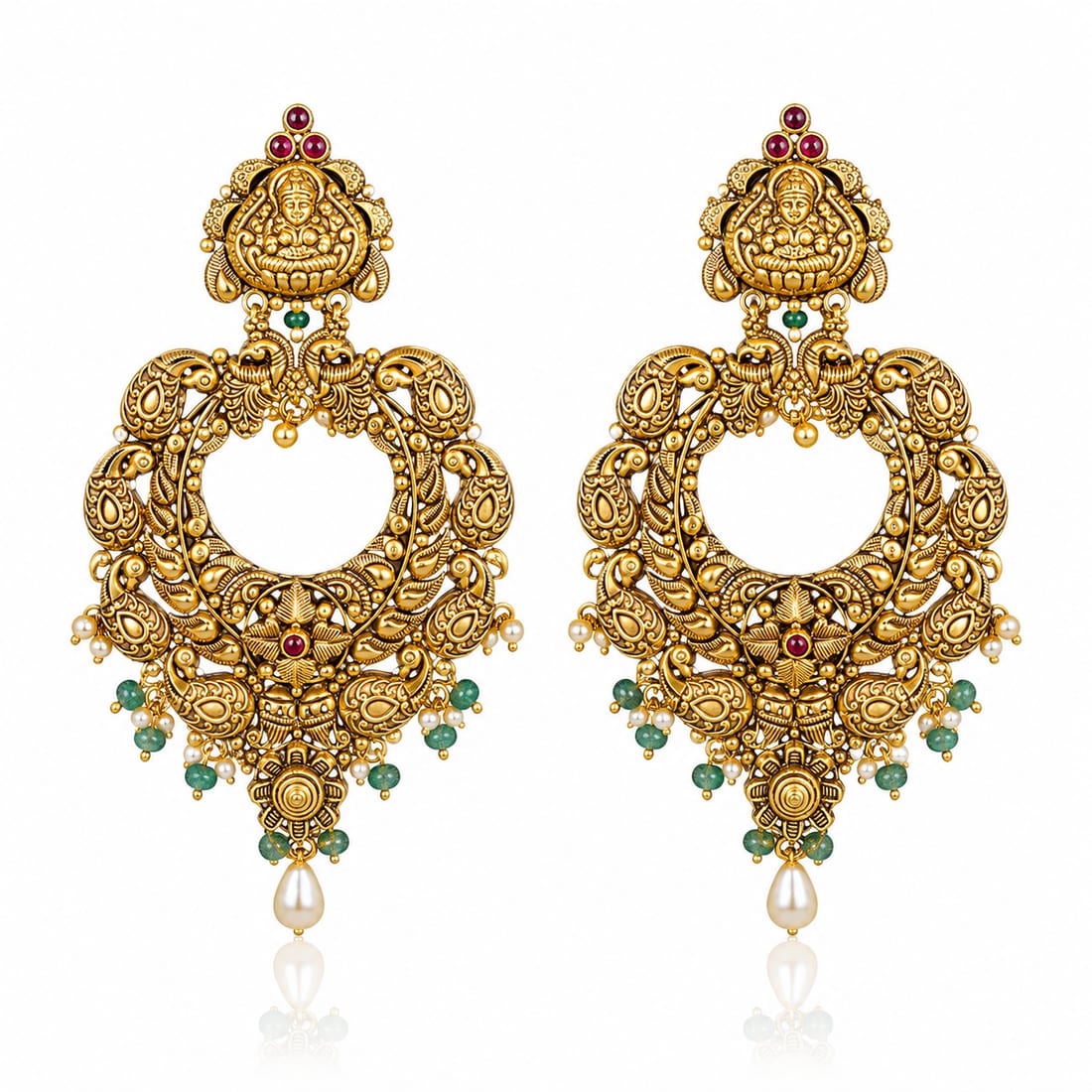
A Lakshmi motif is carved into the top of these temple-style jhumkas, with small ruby and emerald accents worked in around the figure. Depicting Lakshmi, the goddess associated with prosperity, is a long-standing choice for temple jewellery, and the antique gold finish here is meant to echo older, hand-crafted pieces rather than a bright contemporary polish. The jhumka bell hangs below the figural top, giving the earring its traditional dome shape and gentle movement. A wedding and temple-wear piece for anyone who wants figural, symbolic detail rather than a purely geometric design.
Price on request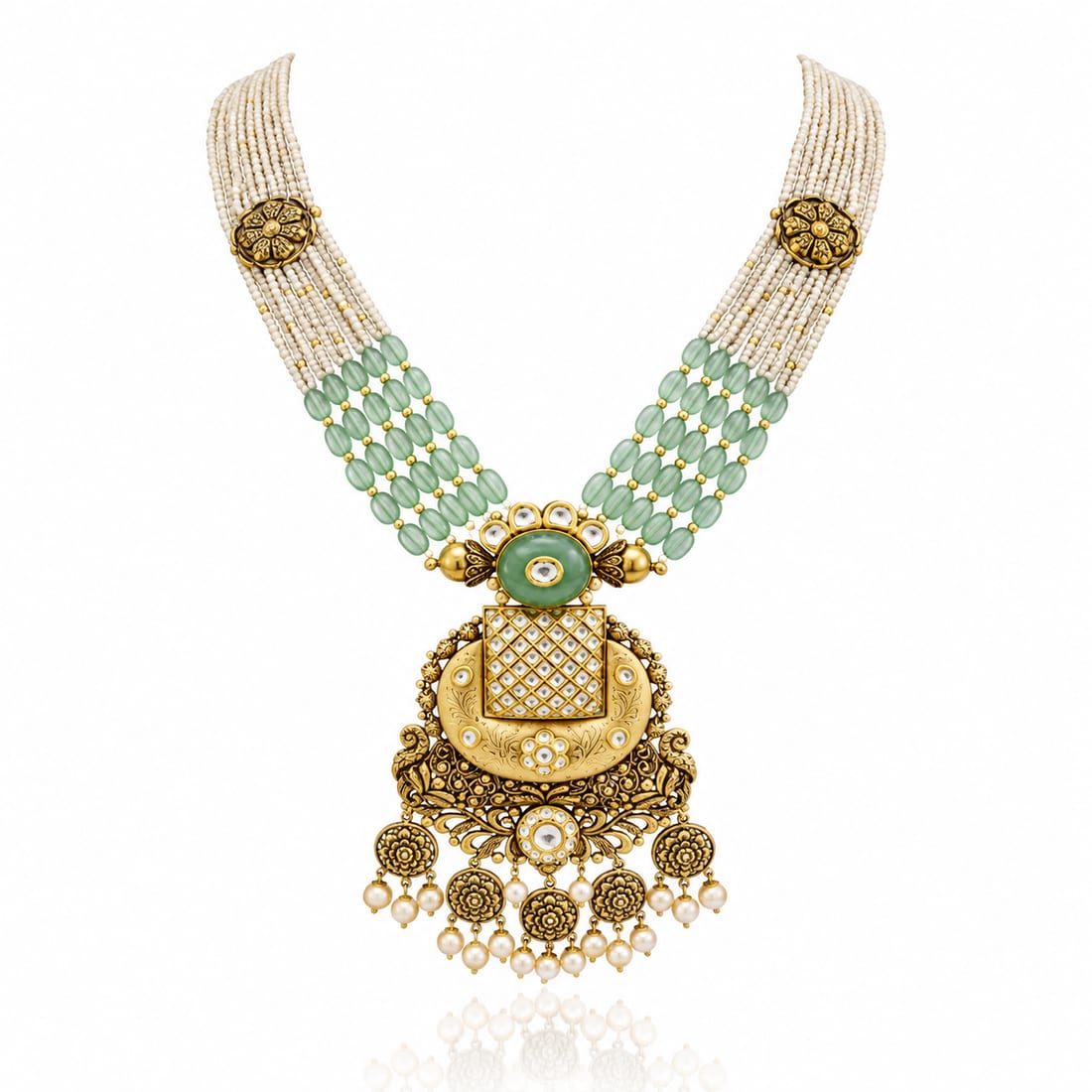
Several strands of green beads layer beneath a single carved gold pendant in this necklace, the beads left slightly uneven in size rather than perfectly matched. That natural variation is typical of hand-strung beadwork, where beads are sorted by eye rather than machine-sorted to an exact diameter. The pendant itself carries nakshi relief carving, giving it more detail than a plain drop would have. Layered but still fairly light to wear, it suits festive occasions as easily as it does a regular day when you want a bit more gold on than usual.
Price on request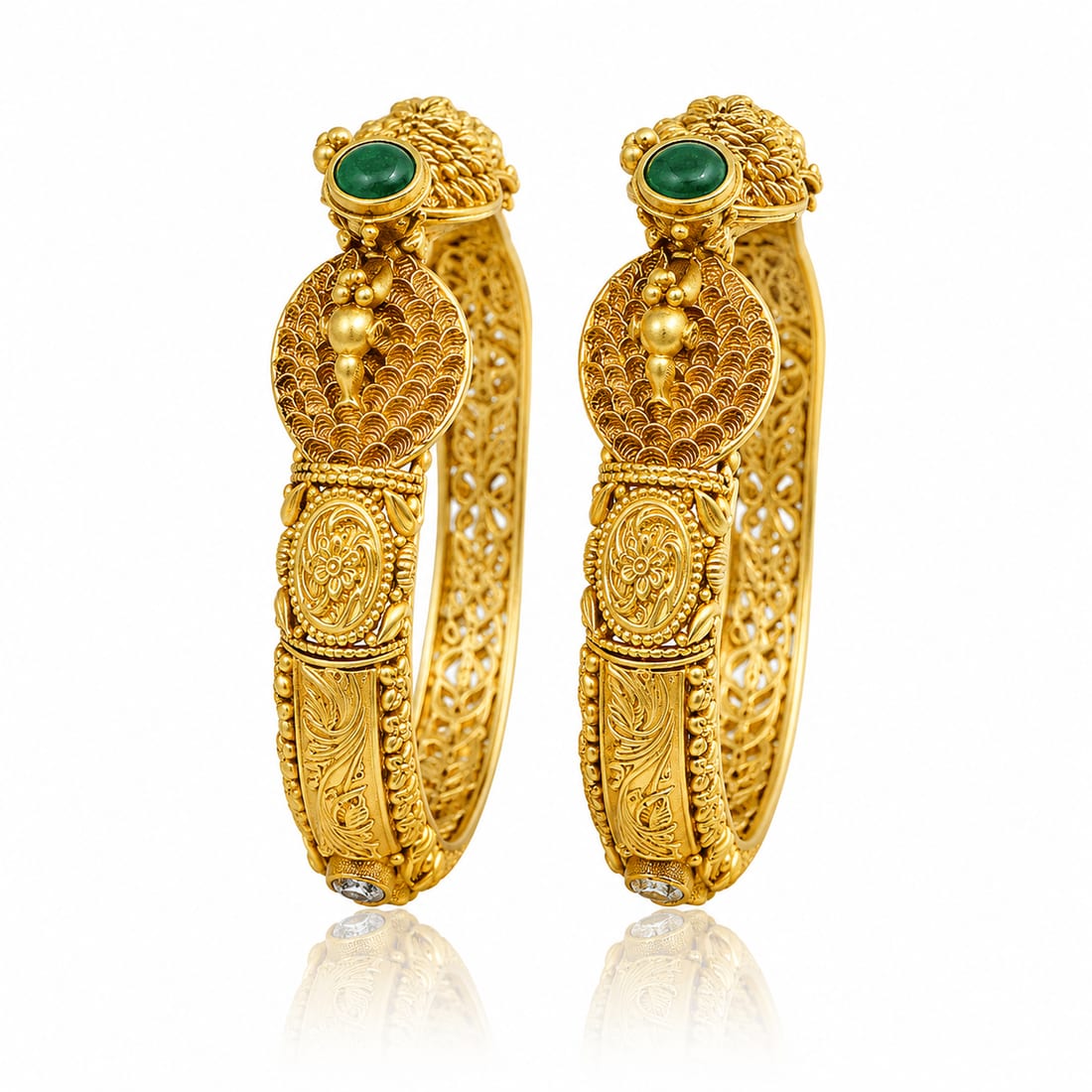
This pair of antique-finish kadas is set with a single emerald cabochon each, the rest of the surface worked in dense hand-carved detail. Keeping to one stone per kada rather than a fully stone-set surface puts the focus on the carving itself, which covers the band in traditional motifs rather than leaving plain sections of gold. Worn as a pair, they're designed to sit together on one wrist or split across both. The antique finish darkens the recesses of the carving so the pattern reads clearly even from a short distance. A wedding and festive choice for those who want carved gold detail over a fully stone-set look.
Price on request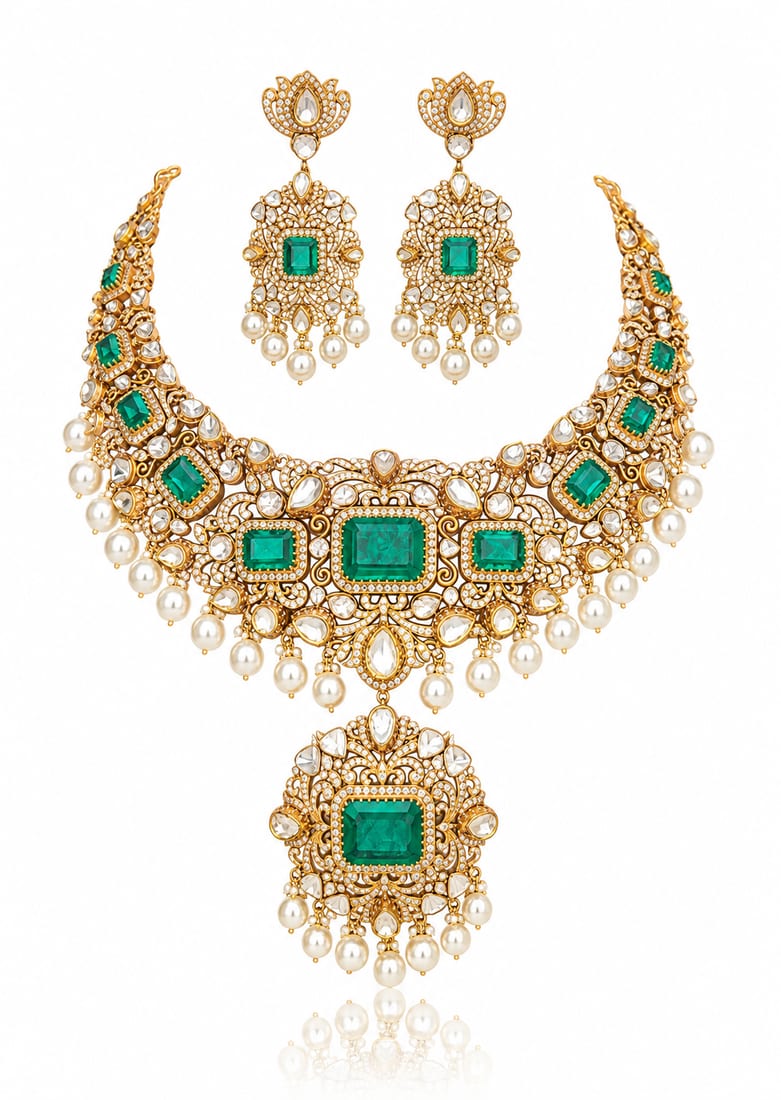
Emerald-cut green stones bloom across this polki bridal set, finished with pearl drops that soften the otherwise structured stone pattern. The emerald accents are cut with flat, rectangular facets rather than left as rounded cabochons, giving them a more contemporary edge against the traditional uncut polki surrounding them. Pearl drops are added at the fringe to introduce movement, since the polki itself sits fairly still against the neck. A full bridal set, built to be worn as the centrepiece of a wedding-day look rather than for smaller occasions.
Price on request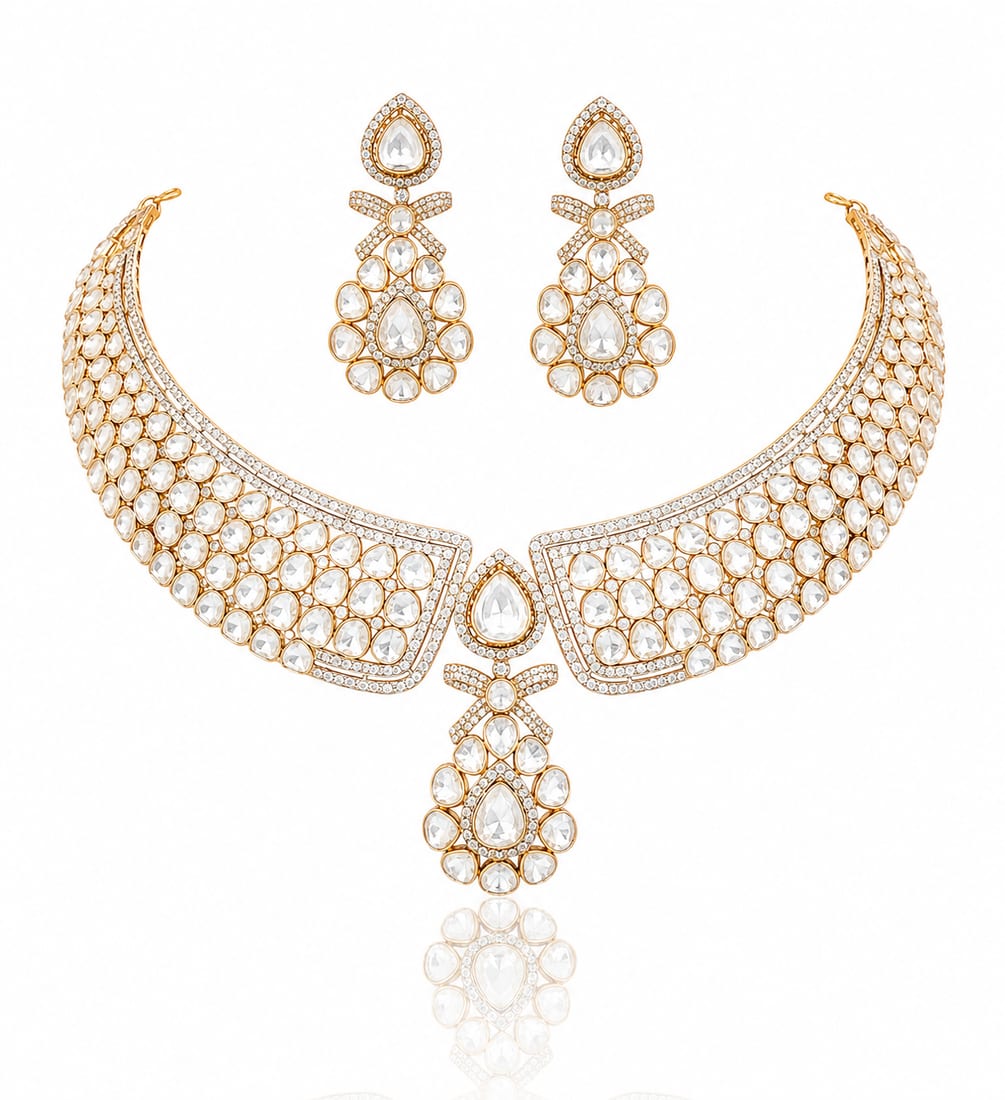
This bridal set keeps entirely to white uncut polki, finished with delicate bow motifs worked into the design at intervals. Skipping coloured stones entirely is a specific styling choice — it keeps the set from competing with a heavily embroidered bridal outfit, letting the polki's natural glint do the work instead. The bow details are a softer, more decorative touch than the geometric patterns typical of most polki work. Hand-set throughout, it's built for bridal wear where an all-white, textured look is preferred over the more common red-and-gold bridal palette.
Price on request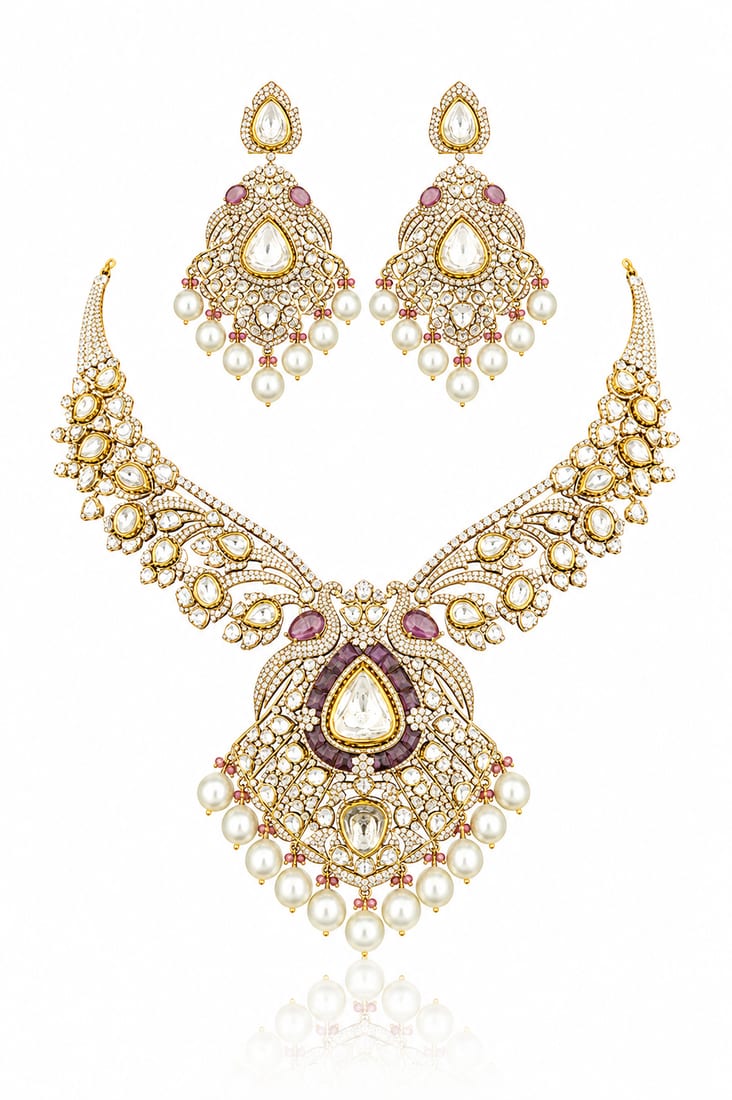
Ruby cabochons and pearls surround a pair of peacock motifs in this bridal set, the peacocks meeting at the centre of the choker in a mirrored design. Peacock imagery has long been part of Indian bridal jewellery, generally read as a symbol of grace and beauty, and it's rendered here in dense polki work rather than as a simple engraved outline. The ruby cabochons are smooth and domed rather than faceted, keeping their colour consistent even in low light. A full bridal set built around a motif with real cultural weight behind it.
Price on request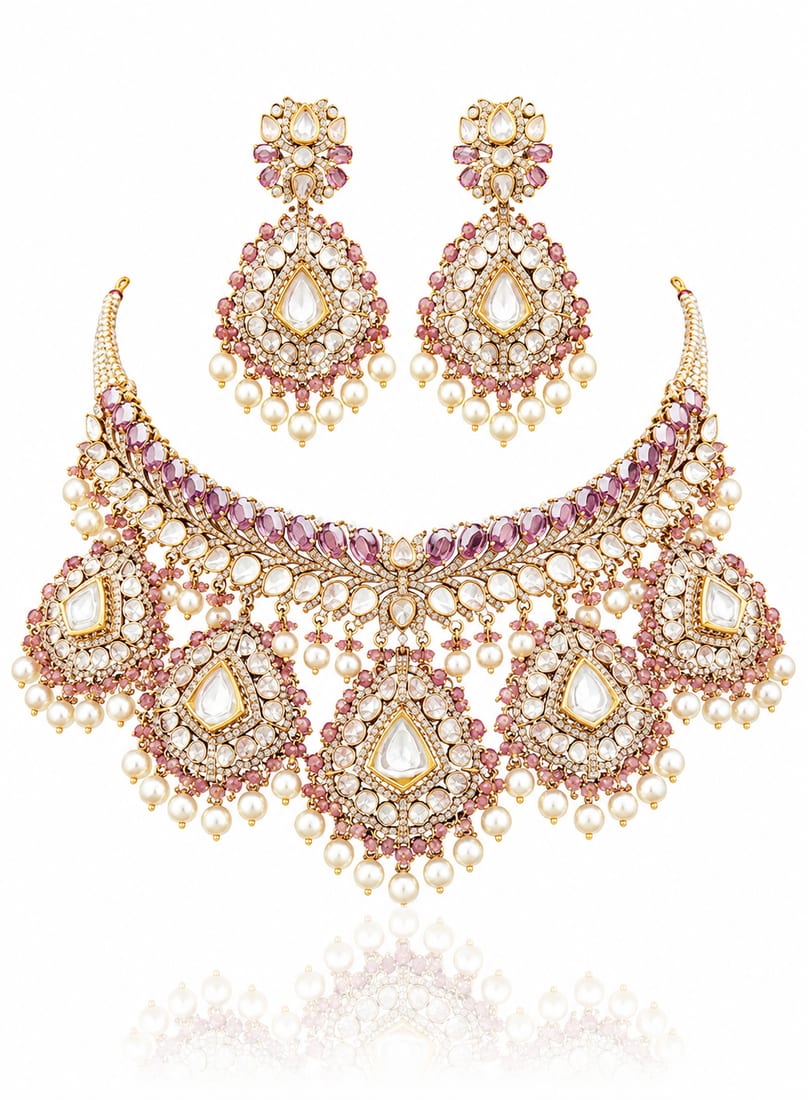
Soft pink stones run through this polki set, finished with a fringe of pearl drops along the bottom edge. Pink is a less common choice than the ruby-red typically seen in bridal polki work, giving this set a gentler, more contemporary bridal palette without abandoning the traditional jadau technique. The pearl fringe adds movement to a piece that would otherwise sit fairly flat against the neckline. Suited to both bridal wear and festive occasions where a softer colour story is wanted instead of the usual red and green.
Price on request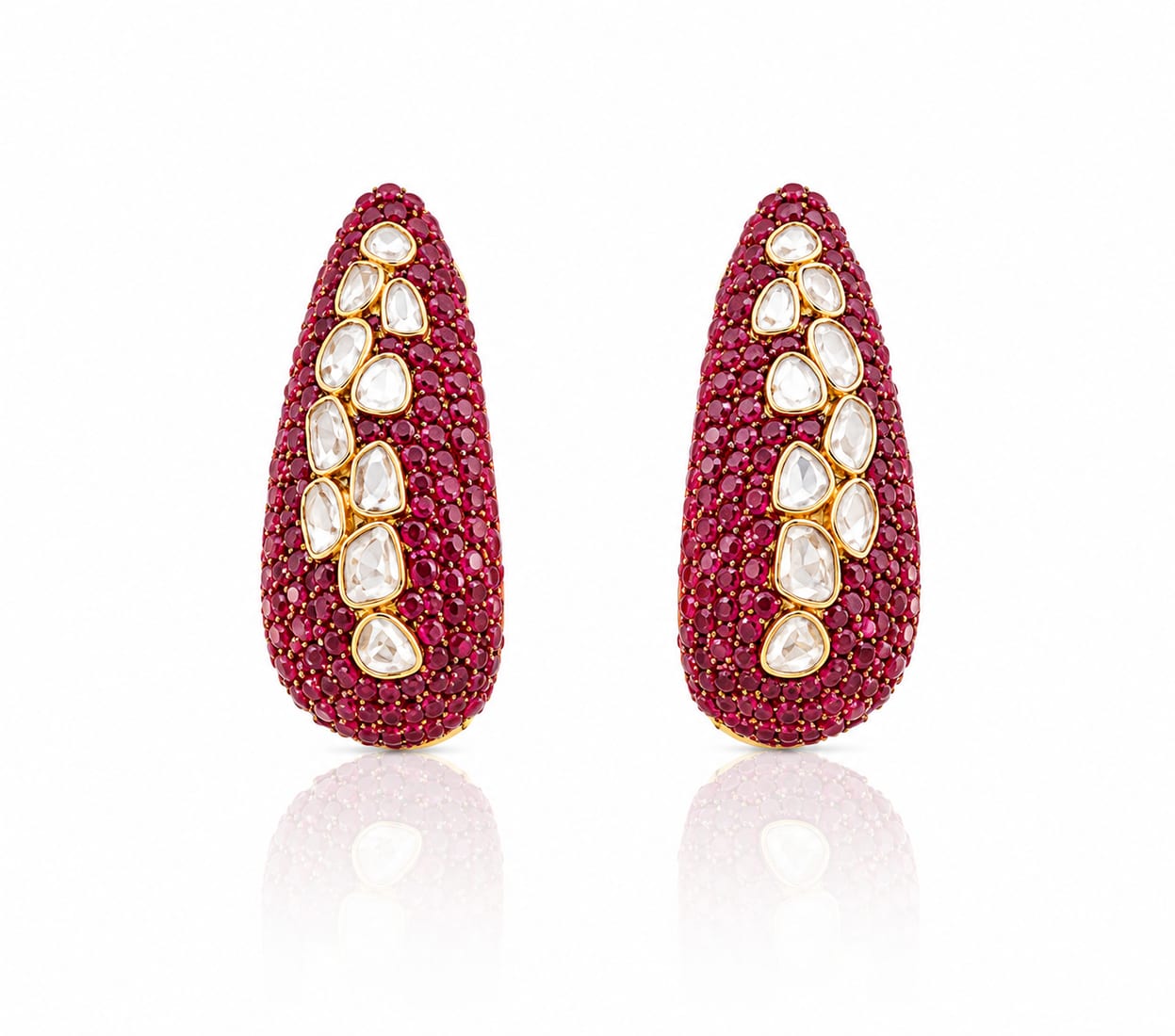
Ruby teardrops are pavé-set in these earrings, trimmed along the edge with uncut polki diamonds. The teardrop shape tapers to a point, giving the earrings a lighter, more wearable drop than a fuller polki design would allow. Pavé-setting the rubies packs them close enough that the red reads as a solid field of colour rather than individual stones. The uncut diamond trim keeps a thread of polki's characteristic glint running along the earring's outer edge. A festive and party-wear pick for when you want colour without the full scale of a bridal-weight piece.
Price on request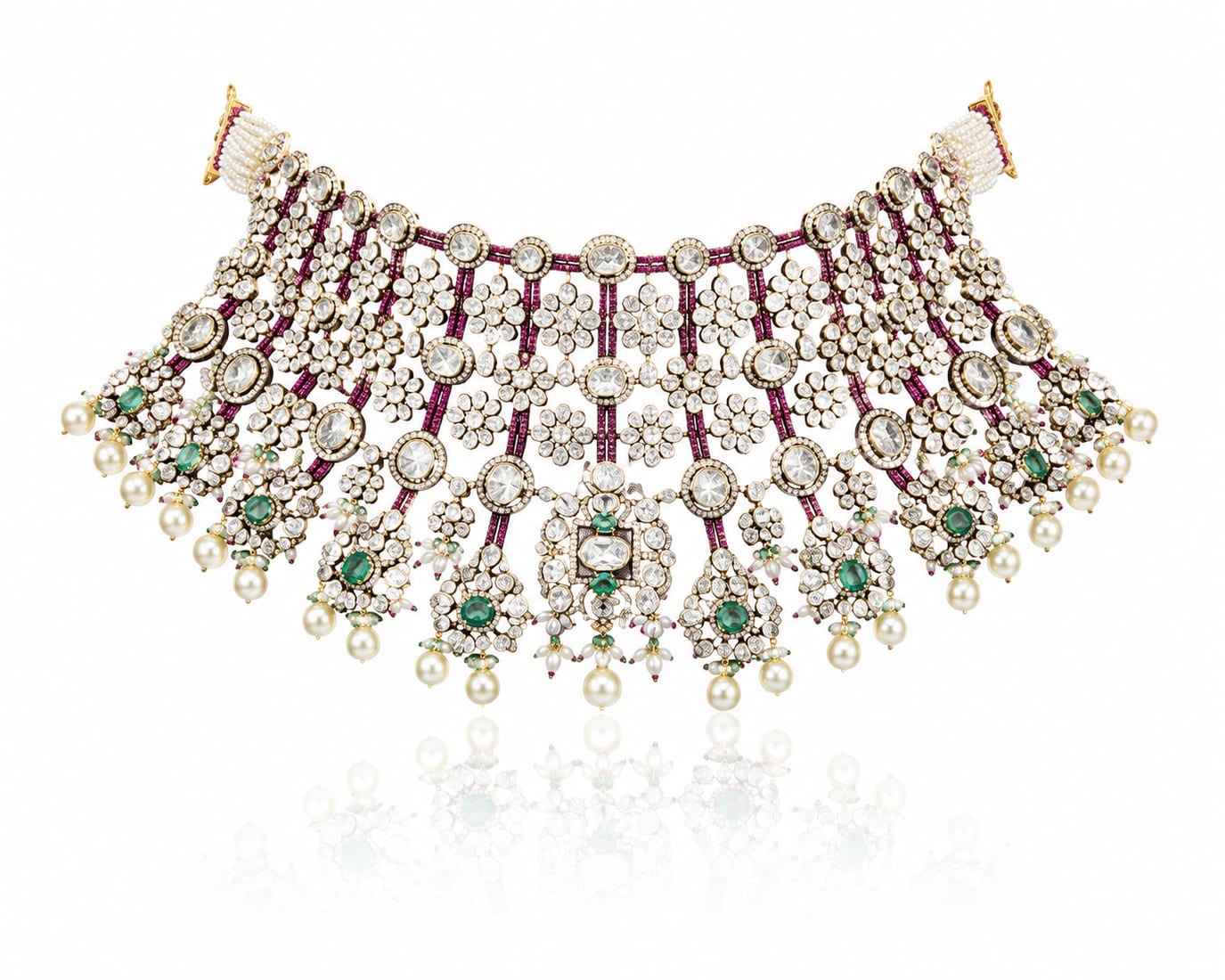
This choker is finished in an oxidized antique tone rather than bright gold, set with rubies and edged with a fringe of pearls along the base. Oxidizing darkens the recessed areas of the metalwork deliberately, a finish that's chosen specifically to make hand-set rubies stand out more sharply against the surrounding gold. The pearl fringe hangs loose enough to move with the wearer rather than sitting rigid. Built for bridal and festive wear where the darker, more antique finish is preferred over the brighter high-polish look of contemporary gold jewellery.
Price on request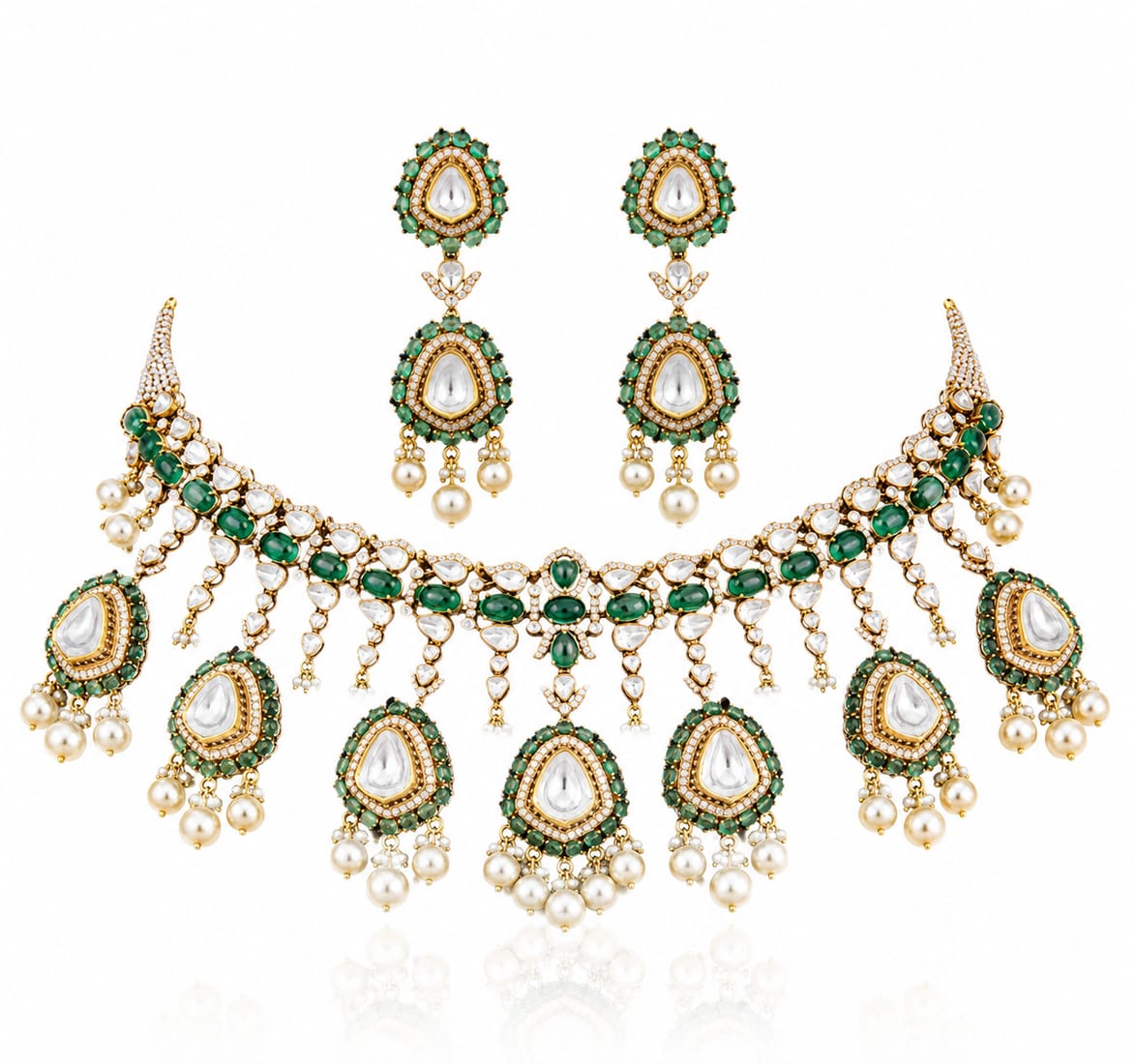
White polki forms the body of this choker, with emerald drops and a pearl fringe hanging below. The emerald drops are placed with intentional spacing rather than uniform repetition, giving the fringe a slightly organic, asymmetrical rhythm as it falls. Jadau-set polki gives the main body of the choker its characteristic soft glint, distinct from the sharper sparkle of faceted diamonds. Suited to both bridal wear and reception functions, where the choker needs to photograph well without being quite as heavy as a full multi-layer bridal piece.
Price on request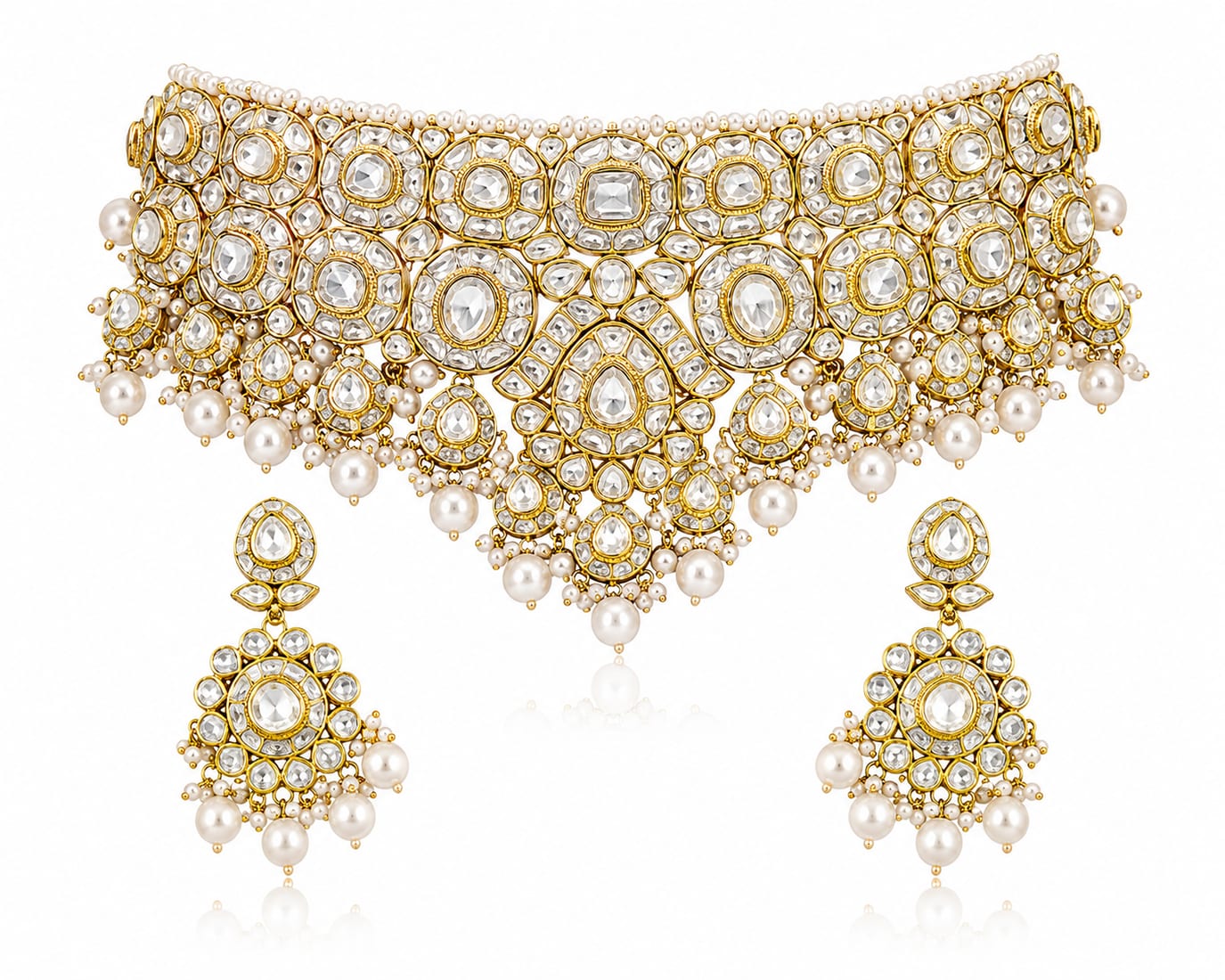
A grand uncut-polki choker, this piece carries emerald and pearl drops across its full width rather than concentrated at the centre. The scale here is closer to a traditional bridal statement piece than a lighter festive choker, with the polki set densely enough that very little base metal shows through. Emerald and pearl drops are mixed along the fringe rather than alternated in a strict pattern, giving the bottom edge some visual irregularity. Built specifically for bridal wear, where its size and hand-set detailing are meant to anchor the entire look.
Price on request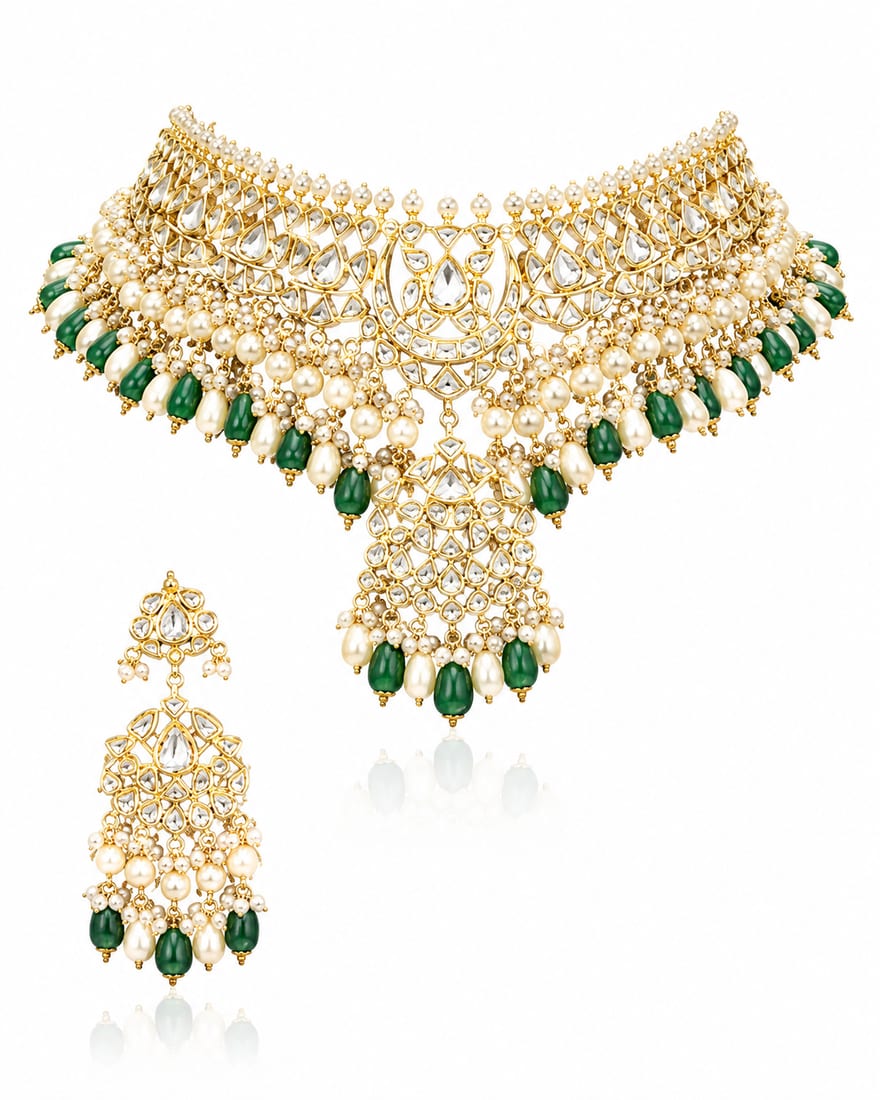
Emerald cabochons are set throughout this polki choker, with matching earrings completing the set. The cabochons are left smooth and domed rather than faceted, which lets them hold colour evenly rather than breaking it into individual glints the way a cut stone would. Jadau setting throughout means both the choker and earrings share the same soft, foil-set glint rather than mixing setting styles within one look. A wedding and festive set built to be worn together, since the earrings are designed specifically to echo the choker's stone placement.
Price on request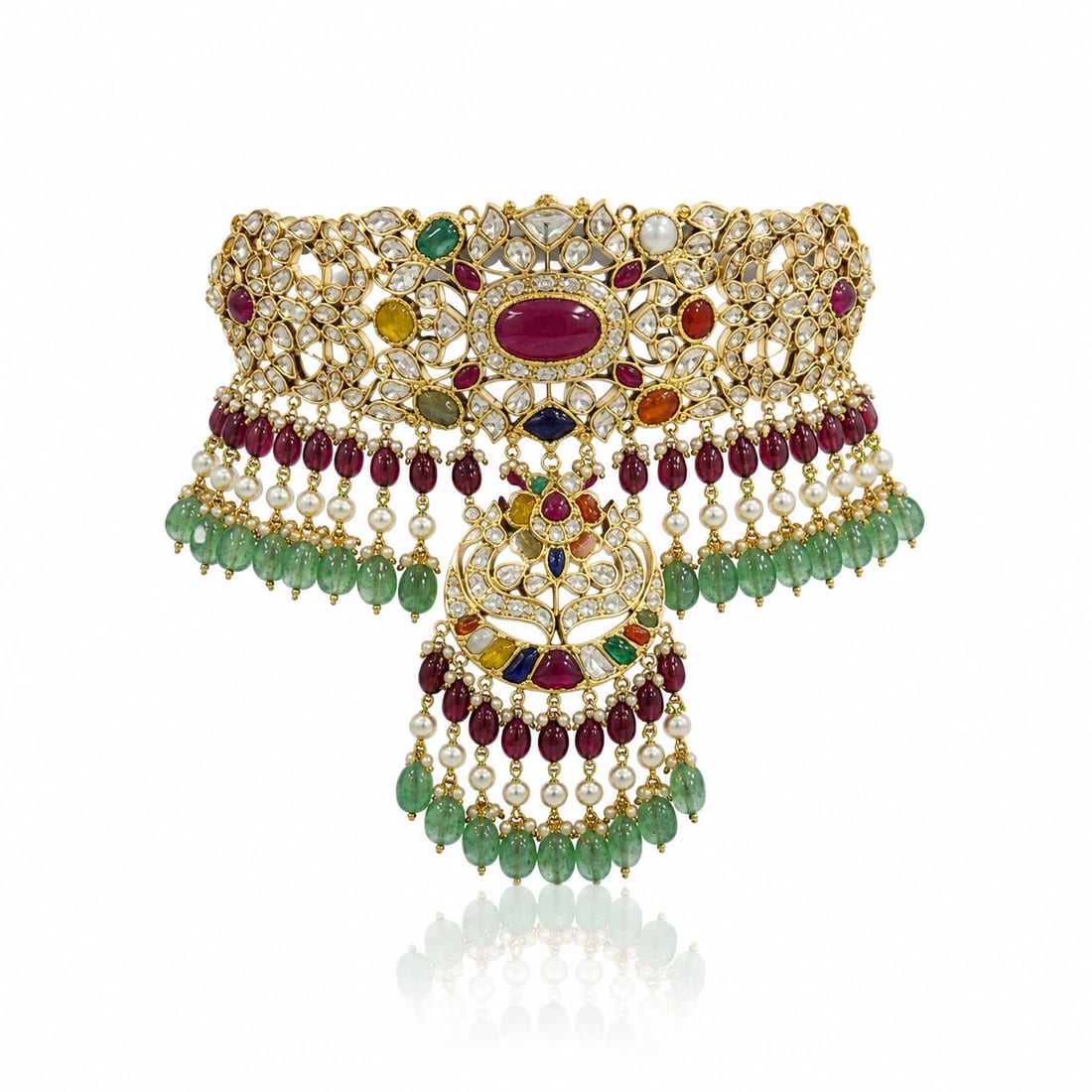
Nine different gemstones — the traditional navratna set — surround an ornate peacock centrepiece on this choker. Navratna jewellery uses nine specific stones together, each traditionally associated with a different planet in Vedic astrology, making this more than just a multicolour design choice. Setting nine different stone types in one piece requires more precise sizing and placement than a single-stone design, since each gem has different hardness and cut characteristics. The peacock centrepiece anchors the whole arrangement. A bridal and festive piece with genuine traditional and symbolic weight.
Price on request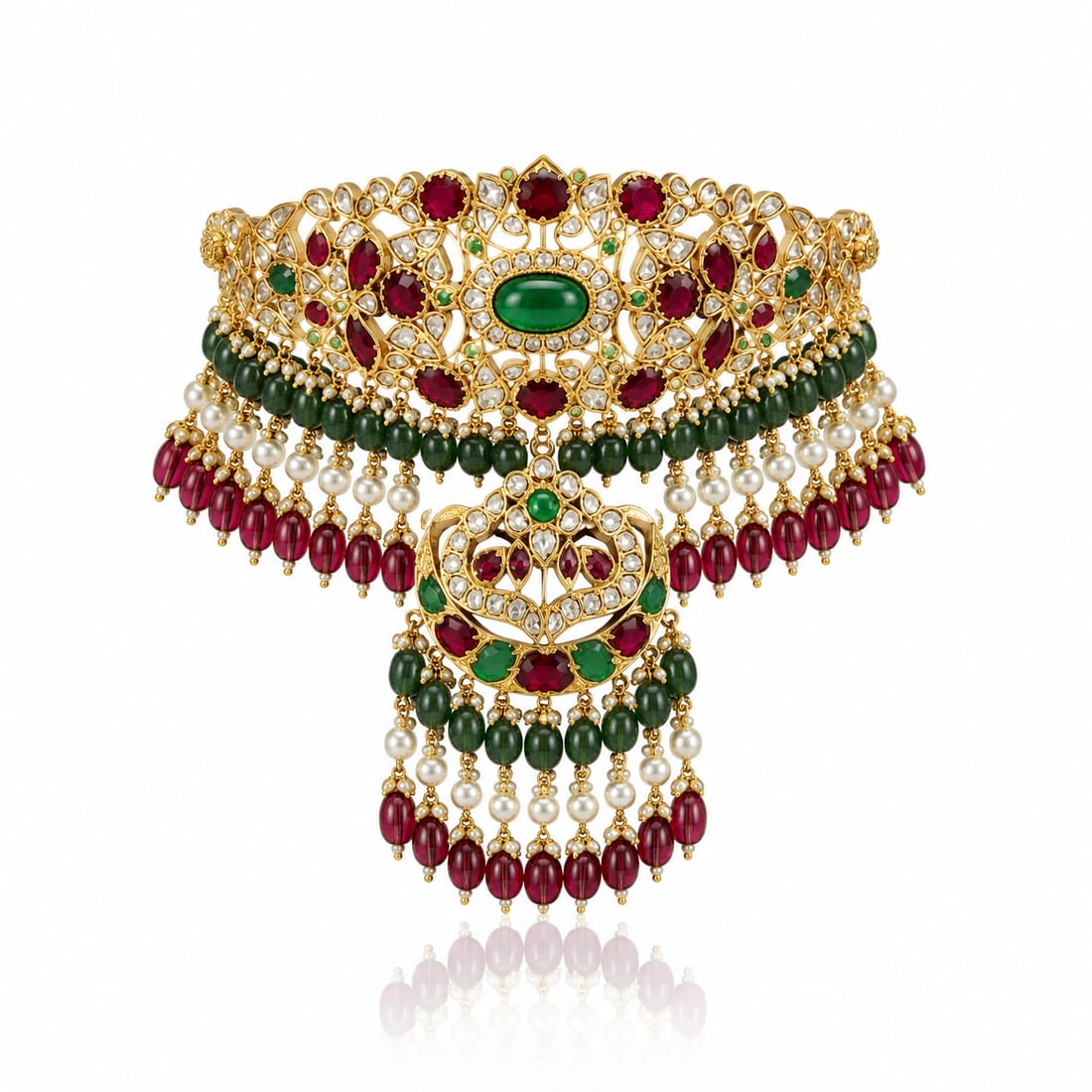
Rubies and emeralds share the surface of this choker in equal measure, finished in an oxidized gold tone with a beaded fringe hanging below. Splitting the design between two coloured stones rather than favouring one creates a busier, more layered look than a single-colour piece, which suits the choker's oxidized, antique styling. The beaded fringe is strung to move independently from the main body of the choker, adding motion to what's otherwise a dense, fixed pattern. Suited to bridal and festive wear where a fuller, more traditional colour palette is wanted.
Price on request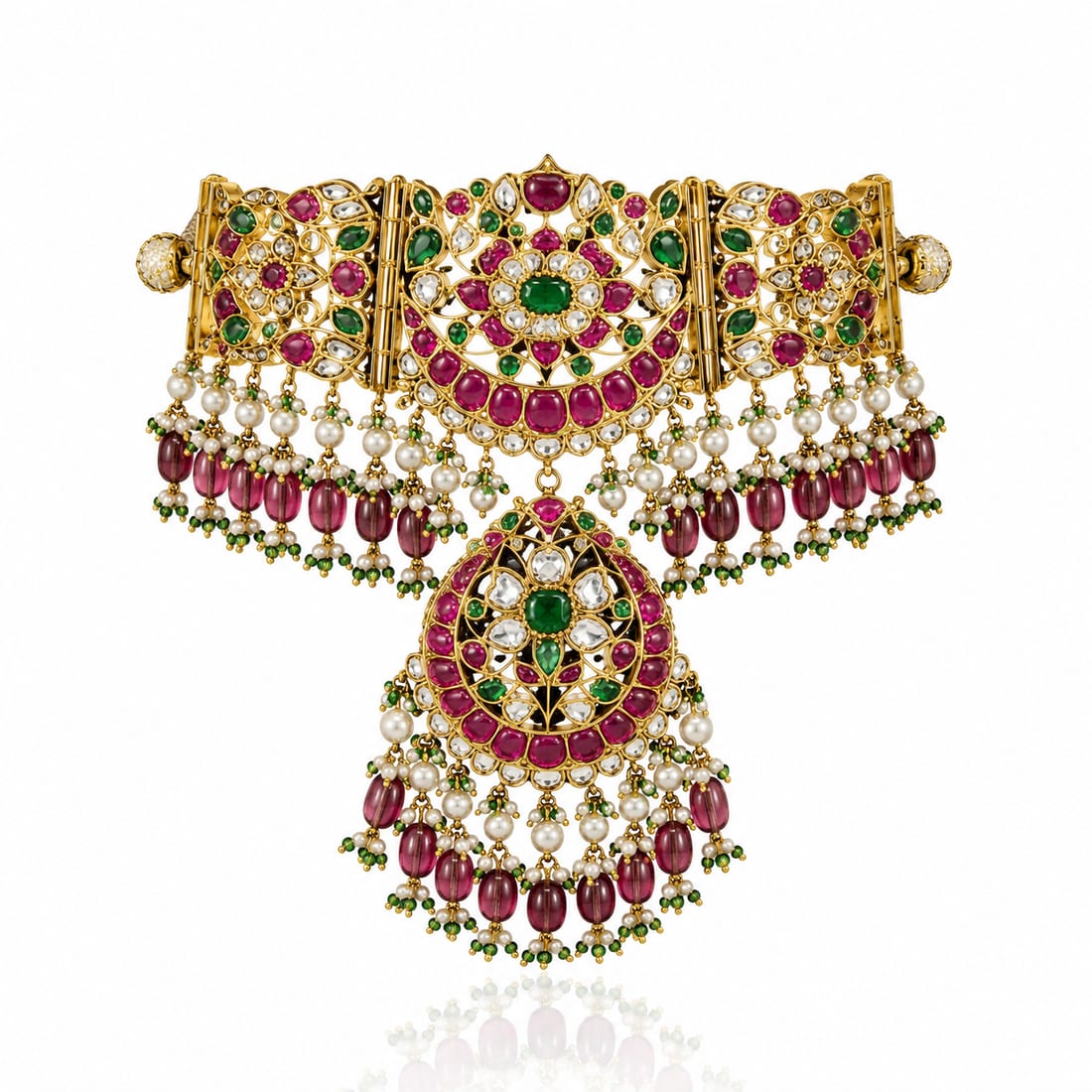
This kada is set with a mix of ruby and emerald cabochons over a base of uncut polki, giving it real visual weight on the wrist. Kadas are traditionally rigid rather than flexible, and this one keeps to that structure, meant to be worn as a statement piece rather than stacked with softer bangles. The ruby and emerald cabochons are placed asymmetrically rather than in a strict repeating pattern, which is typical of hand-set jadau work. A bold bridal and festive choice for anyone who wants their wrist jewellery to match the scale of a full polki neckline.
Price on request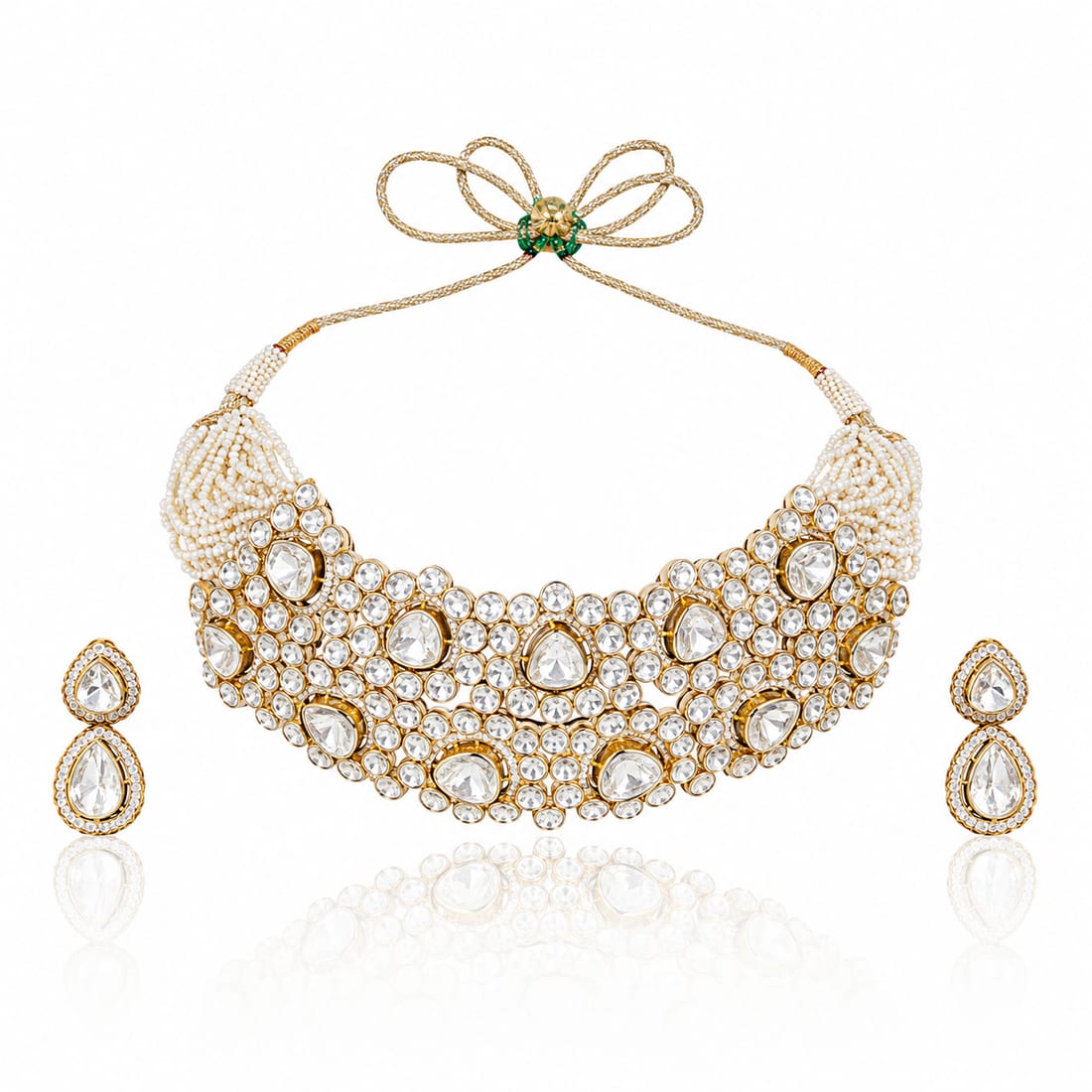
An all-white polki choker finished with a decorative bow clasp at the centre back, this set pairs with matching drop earrings. The bow clasp is a detail most people won't see while it's being worn, but it's finished with the same care as the visible front of the choker, which is typical of how these pieces are actually made. Keeping to white polki throughout gives it a cleaner, more versatile look than a piece mixing in coloured stones. Works for both bridal wear and reception functions, where a lighter, all-white choker is often preferred over a heavier coloured design.
Price on request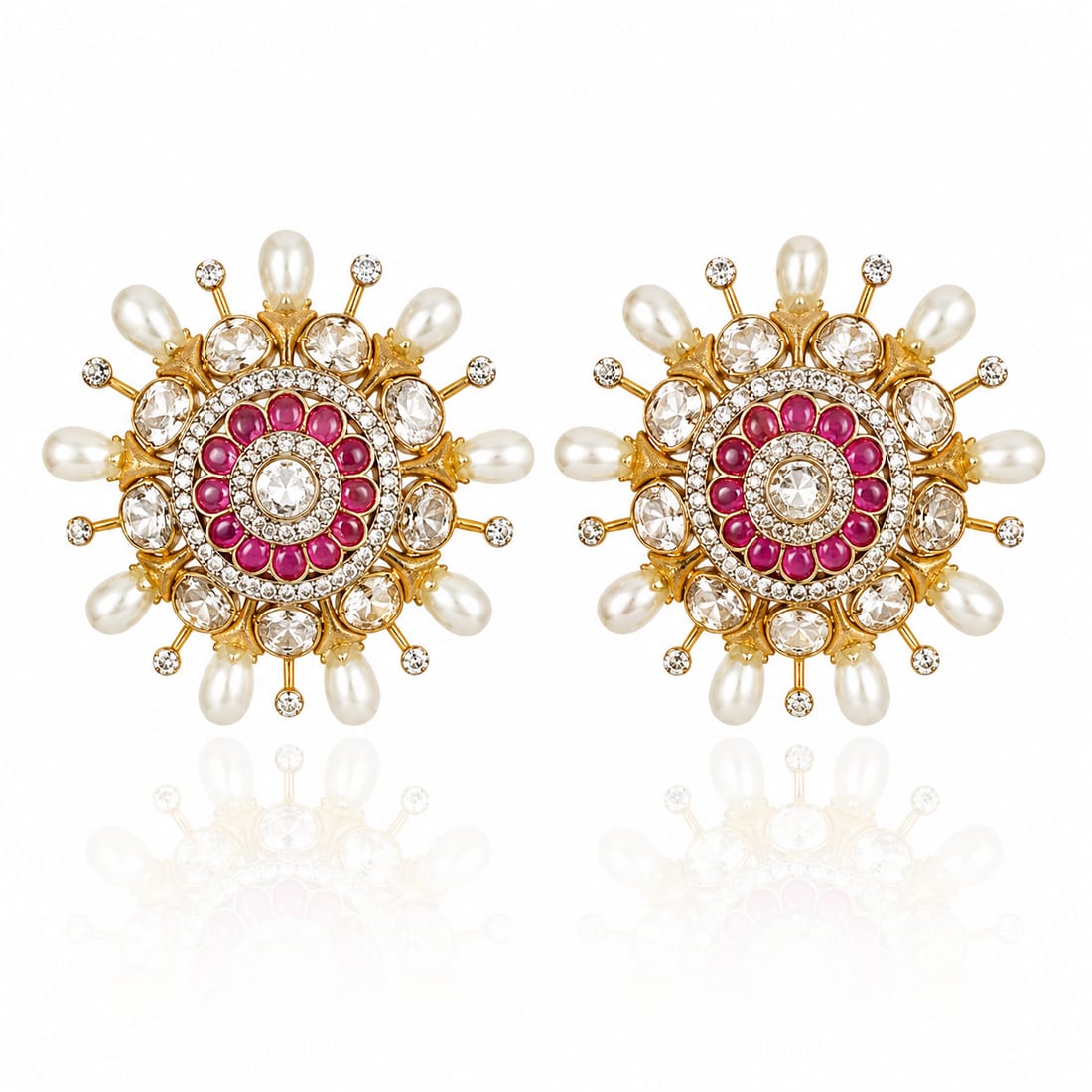
Pearls and diamonds radiate outward from a ruby centre in these earrings, arranged in a starburst pattern rather than a standard drop or stud shape. The radiating design means the earrings catch light from multiple directions at once rather than along a single line, giving them noticeably more sparkle for their size. Pavé-setting the rubies and diamonds keeps the surface dense, so very little metal shows between the stones. A festive and party-wear choice when you want a statement earring that doesn't require an equally elaborate necklace to balance it.
Price on request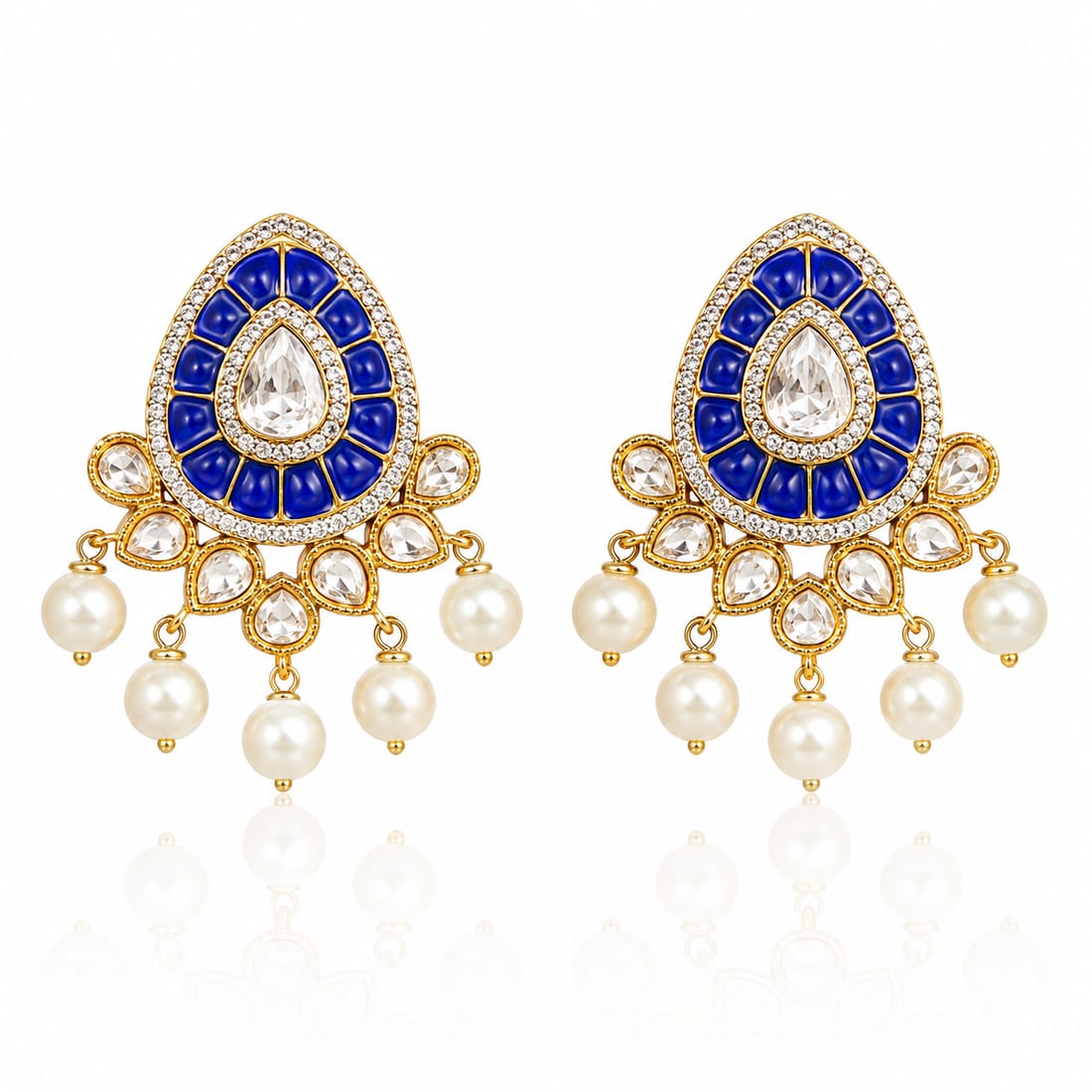
Blue meenakari enamel forms the base of these teardrop earrings, set with uncut polki diamonds and finished with pearl drops. Combining meenakari enamel work with polki setting on the same earring means two separate hand-craft techniques go into a single piece — the enamel fired first, then the polki set into the remaining gold framework. The blue provides a colour anchor that the white polki and pearls play off rather than compete with. A festive and wedding-wear pick for outfits already built around a blue or jewel-tone palette.
Price on request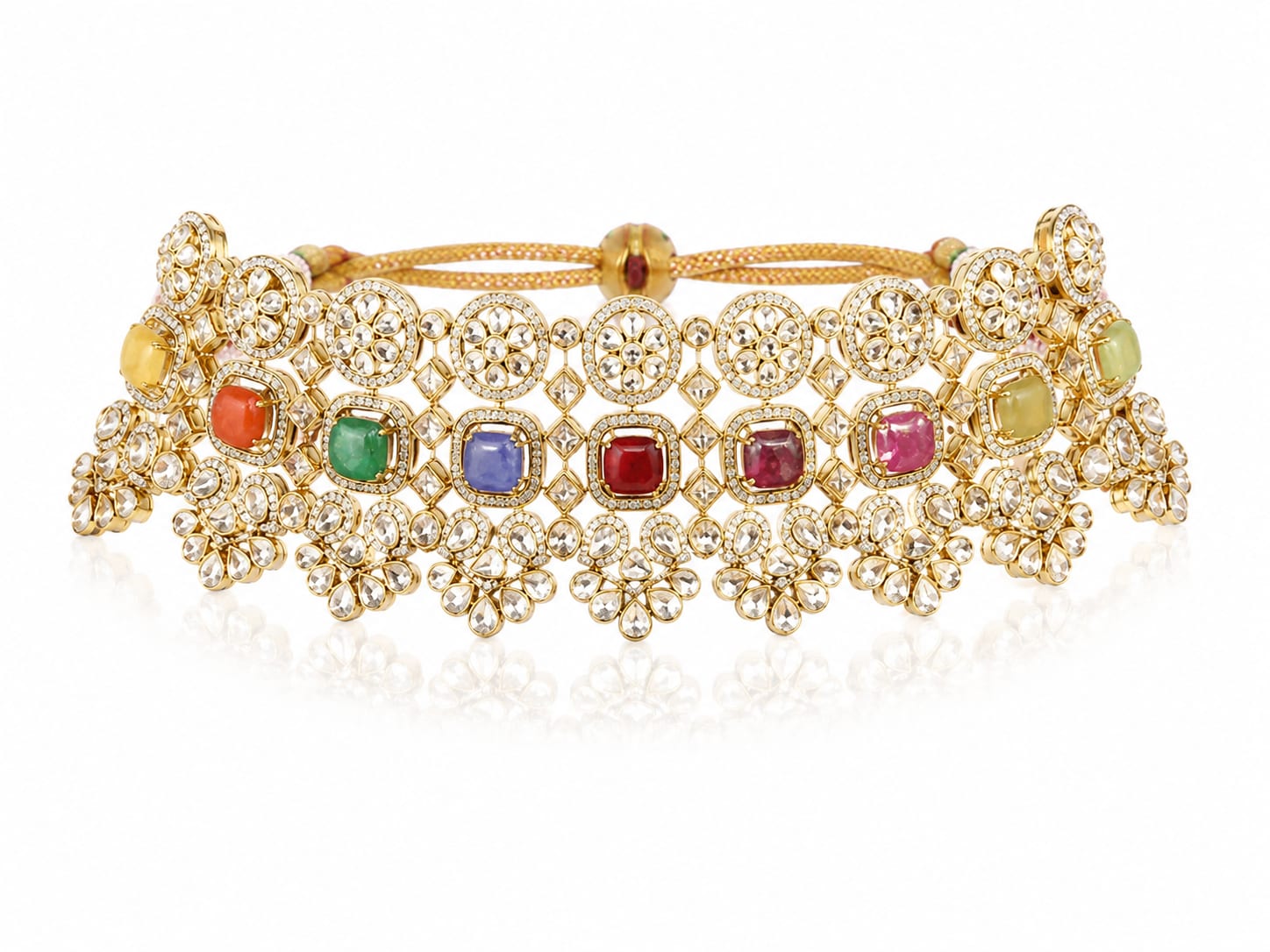
The nine navratna stones are worked into a floral lattice of uncut polki on this choker, rather than isolated as individual settings. Weaving the navratna stones into a continuous floral pattern, instead of placing them as separate accents, takes more planning at the design stage since each of the nine stones needs to sit within the lattice without disrupting its symmetry. The polki lattice itself provides the connective structure between each gemstone. A bridal and festive choker for those who want the traditional navratna symbolism presented in a more decorative, less segmented design.
Price on request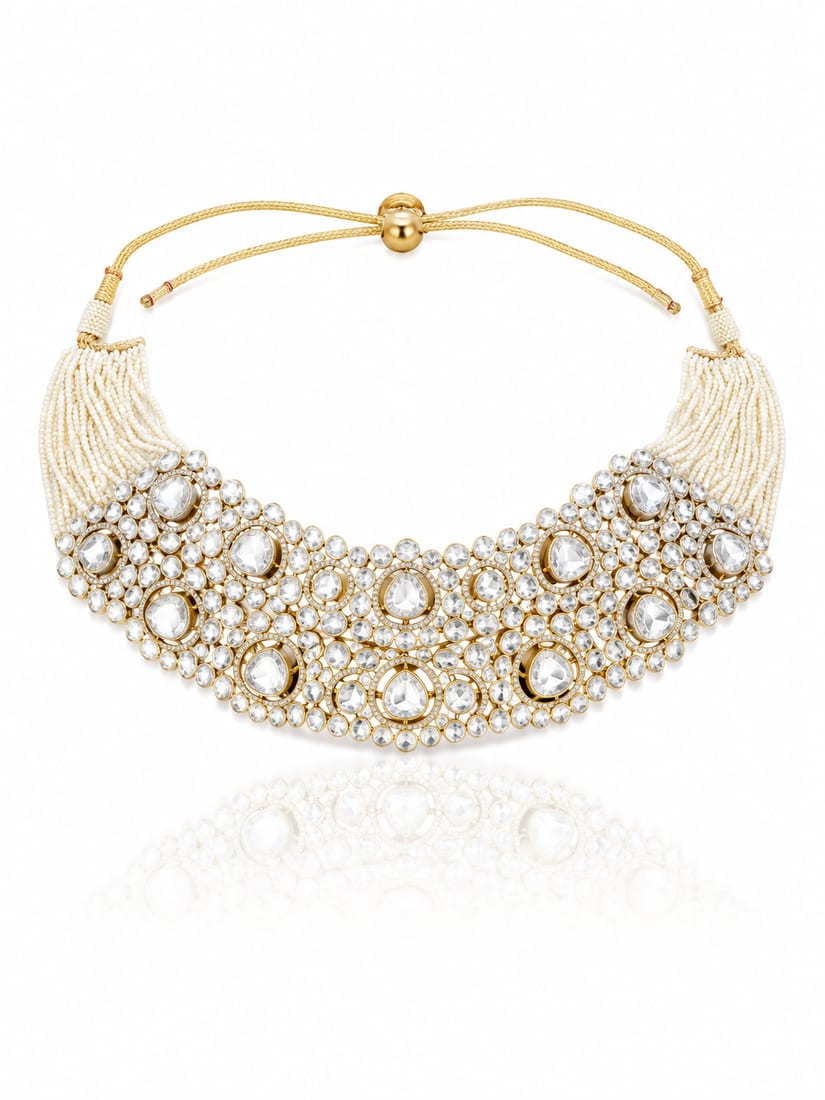
Multiple strands of pearl cord support this choker, leading up to a broad panel of hand-set white polki at the front. Using pearl cord instead of a solid metal band for the sides makes the choker considerably more adjustable and comfortable around the neck, since the cords can shift slightly rather than sitting rigid. The polki panel itself is left entirely white, letting the diamonds' natural glint carry the design without added colour. Built for bridal wear, where its combination of a substantial front panel and a lighter, adjustable back makes it easier to wear through a long wedding day.
Price on request